

Lech Wałęsa is one of Europe’s most respected statesmen. A pro-democracy activist imprisoned in Communist Poland, he won the Nobel Peace Prize and went on to become the first democratically elected president of Poland. He is a longtime friend of Taiwan, having visited the country seven times, including as president in early as 1996, and has long championed Taiwan’s democracy and successes as a nation.
So it was absolutely shocking when he stood before a crowd of Taipei’s foreign policy elite at the annual Yushan Forum, following a public audience with the President of Taiwan, and declared his support for “the unification of the Chinese people,” or subsuming Taiwan into China, which it has never been part of.
Declaring that “Chinese nations have to unite, but Taiwan should lead the unification of the Chinese people,” Mr. Walesa parroted the propaganda of long-dead dictator Chiang Kai-shek, who killed 30,000 Taiwanese and imposed the world’s longest period of martial law in order to assert his vision that Taiwan was part of a singular Chinese nation that must one day be unified. It is also the language of Xi Jinping, who has declared that “reunification is unstoppable.”
If Mr. Walesa had actually bothered to ask Taiwanese people how they felt about their identity or whether they wanted to join China or not, he would have discovered only 7.2% support “unification,” and a mere 2.5% of the country identifies primarily as “Chinese.”
The Yushan Forum, organized annually by the Ministry of Foreign Affairs and the government-funded Taiwan Asia Exchange Foundation, is meant to promote Taiwan’s ties with South and Southeast Asia under the New Southbound Policy Plus. It is considered, along with the Ketagalan Forum, to be one of the highest-level foreign policy meetings in Taiwan.
Taiwan’s Central News Agency attempted to somewhat paper over the embarrassment by mistranslating his comments as “Chinese-speaking areas must unite,” although the ultra-green Liberty Times reports his remarks as “the Chinese nation must unite,” (中華民族必須統一).
Formosa Review can confirm that Walesa, speaking through a Polish-Mandarin interpreter, referred to the Chinese nation, not language. His original remarks in Polish cannot be confirmed at this time, and may never be, given that Walesa’s dialect is famously so irregular that an entire Master’s dissertation has been written on how difficult it is to interpret for him. New sourcing reveals his comments in the original Polish state: “Chinese nations must unite” (Narody chińskie muszą się zjednoczyć).
The fundamental dispute between Taiwan and China is not about democracy versus authoritarianism, capitalism versus communism, or lèsè versus lājī. It is a dispute of national identity.
Ironically wearing a Ukrainian flag pin, one must wonder if Mr. Walesa truly believes that areas speaking the same or similar languages must unify. Surely, he must also support the unification of the Donbas and Crimea with Russia? And why should China stop at Taiwan? Certainly Singapore, major Malaysian cities, and a few chunks of Vietnam must join the Chinese nation-state as well. For good measure, Flushing, Queens could be thrown in too.
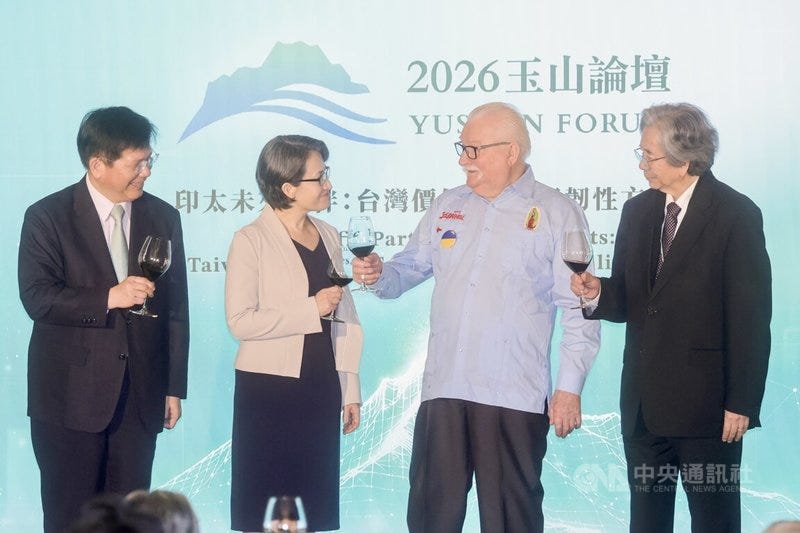
Poland fought long and hard for its independence, both as a nation state in its own right, and for true sovereignty against the yoke of Soviet oppression. But when Mr. Walesa was languishing in Communist jails, should he have taken solace in the fact that Poland was better off under the domination of a fellow Slavic-speaking nation?
Mr. Walesa’s qualification that democratic “Taiwan should lead the unification” makes no more sense than stating that democratic Ukraine should lead unification with Russia. Ukraine is an independent nation state that doesn’t want to be part of Russia, and Taiwan is another independent nation state that doesn’t want to be part of China. While both share cultural and historical links with their neighbors, the idea that democracy would be a saving grace belies the very nature of democracy: majority rule over the minority. No nation would willingly give up its sovereignty to any foreign state just because it embraces democracy.
The fundamental dispute between Taiwan and China is not about democracy versus authoritarianism, capitalism versus communism, or lèsè versus lājī. It is a dispute of national identity.
When Presidents Trump and Zelensky had a famously contentious White House meeting last year, Mr. Walesa wrote Mr. Trump a letter castigating him for berating Mr. Zelensky, expressing his “horror and disgust.” Why did he not instead suggest that Zelensky, a native Russian speaker, lead efforts to unify with Russia?
Despite seven high-profile visits to Taiwan over 30 years, Lech Walesa has never bothered to learn basics of the country, its people, and its long struggle for democracy and self-rule. For more than a hundred years, against the Manchus, the Japanese, and the Chinese Nationalist Party (KMT), the Taiwanese people have bravely fought for freedom and democracy, often paying the ultimate price. It is a story the people of Poland should find familiar.
Whether by intention or ignorance, Mr. Walesa has handed Xi Jinping and the Chinese Communist Party a propaganda gift by repeating their narratives nearly word for word.
Given the high price Taiwanese have paid, and are willing to pay, for their freedom, why did the Taiwanese government give such a large platform to someone who used it to insult the dignity and desires of the Taiwanese? Even worse, Formosa Review can confirm that a sum of as much as half a million Taiwanese dollars (approximately $15,000 USD) was awarded by the Foreign Ministry as a speaking fee.
High-level sources in Taipei confirm that the invitation to Mr. Walesa was at the explicit request of Foreign Minister Lin Chia-lung, who came to know Walesa in his previous visits to Taipei, particularly under the administration of President Chen Shui-bian, under whom Mr. Lin served as Deputy Secretary-General to the President.
Foreign Minister Lin also happens to be married to the heiress of the Chi Mei Group, which has extensive investments in Poland, and he has made frequent visits to the country during his tenure as foreign minister, in both official and unofficial capacity. His official activities may all be above board, but they go a long way to explaining why a long-retired Polish politician was paid handsomely to address a forum on strengthening Indo-Pacific partnerships.
It is not the first time Taiwan has erred so spectacularly: previous invitations and exorbitant speaking fees to disgraced former leaders such as Boris Johnson (who also seemed to think Taiwan and China were one nation) and Liz Truss have garnered Taiwan far more embarrassment than support.
But it should be the last.
CORRECTIONS:
On Mar 17 this article was updated to include the original Polish remarks.
On Mar 18 this article was updated to reflect that Walesa’s presidency ended in 1995, not 1996.
As a Polish national and a Taiwan GC holder I can only say I’m sorry about this bullshit. While we value his contribution to Polish democracy, he is not representing the Polish state/people anymore and had a ‘thing’ for making stupid comments even in presidential election debates…
What was he thinking, I don’t know. Even for his own sake getting paid to come here, one might think he will not ‘bite the hand that feeds him’… honestly no words can explain this