

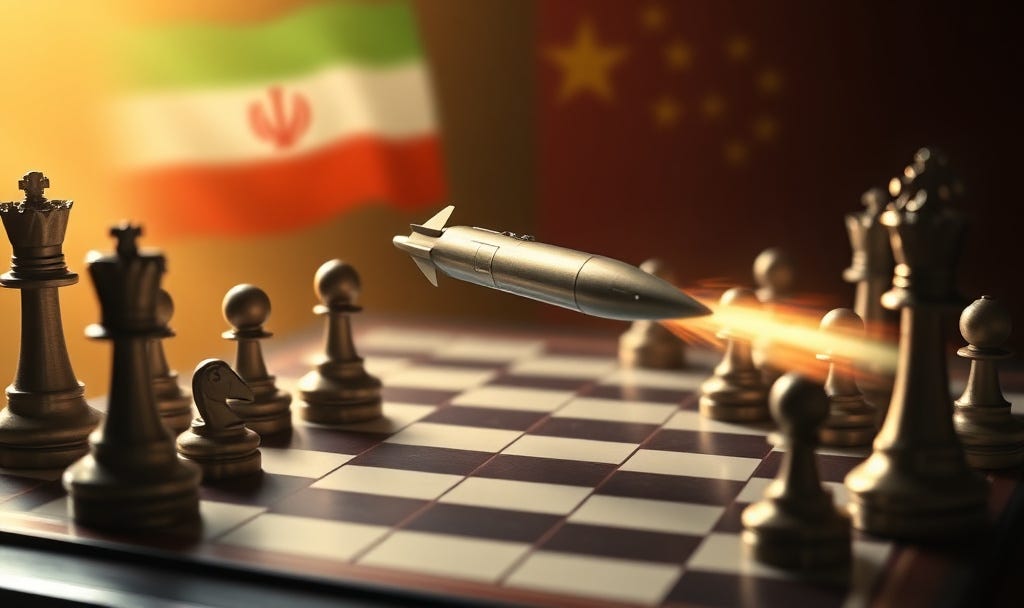
The raging US-Israeli war on Iran has produced no shortage in takes and analyses of how this will impact the Indo-Pacific. But the most disturbing thread has been an ongoing campaign to cast this war as some sort of “5D chess move” against China, claiming that the war is either primarily motivated by a strategy to contain China, or otherwise will have the effect of deterring Chinese military action against Taiwan.
Nothing could be further from the truth. In fact, every day the war continues, Taiwan falls into a more precarious position, along with America’s other East Asian allies.
This essay will first recount the range of arguments offered supporting the idea that the Iran war deters or weakens China, after dismantling them, I will outline the war’s impacts on the US-China balance of power in the Indo-Pacific, and how it directly imperils Taiwan’s security. Finally, I will analyze Taiwan’s responses to the war and the lessons it needs to draw from the conflict.
This is the first in a series of exclusive exposés of how US policy in the Middle East impacts Taiwan, and Taiwan’s misguided foreign policy objectives in the Middle East. Future articles will address the influence of AIPAC and pro-Israel lobbying efforts in Taipei, which have produced this distortion, and how Taiwan’s Middle East policies have set it on a path to losing support in the United States and around the world. Subscribe today to receive early access to these exclusive reports, which contain never before published scoops from on the ground in Taipei.
Myth #1: The Iran War is all about containing China.
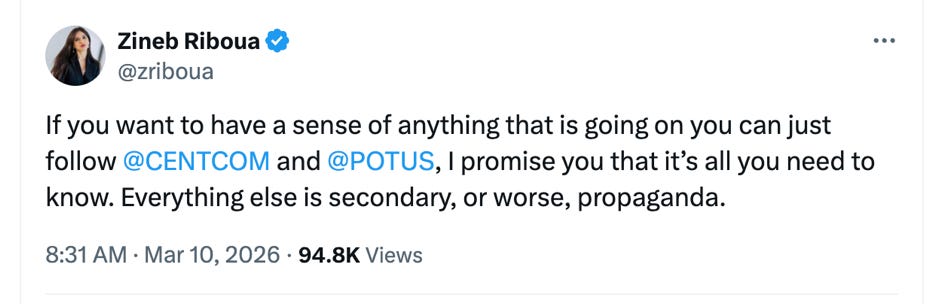
This myth claims that despite common interpretations, the Trump Administration’s primary motivation and strategic goal for attacking Iran is to contain China. This most circulated version of this argument, The Iran Strike Is All About China, has been articulated by right-wing blogger Zineb Riboua, who has argued that the only legitimate source of information about the war comes from Donald Trump’s Twitter account.
Let’s examine the evidence to the contrary: numerous administration officials, including Secretary of State cum National Security Advisor Marco Rubio, Speaker Mike Johnson, and Donald Trump himself have all made it clear that Israel was the driving factor behind the war. Extensive reporting in the New York Times, Wall Street Journal, and Bloomberg has outlined how Benjamin Netanyahu worked aggressively to lobby Trump to strike Iran, a forty-year goal of his, cultivating Lindsey Graham to directly persuade Trump.
The recent resignation letter of National Counterterrorism Center Director Joe Kent, and accounts from foreign diplomats privy to the US-Iranian negotiations bring additional confirmation. The White House has also copy and pasted a document produced by an Israeli influence operation to justify the war.
There are also various public explanations the administration has trotted out to attempt to sell the war to a skeptical American public: destroying Iran’s conventional ballistic missile capabilities, claims of a restarted nuclear program, retaliation for proxy attacks on Americans and Israel, or to support a democratic uprising by the Iranian people.
Not once do any of these officials claim this is driven by a need to contain China, even as the administration has raised the China angle to justify military operations against Venezuela and Greenland.
This raises an extremely important counterfactual: there is bipartisan consensus on the need to contain China, a position which is also popular with the general public. According to polling from Pew, when asked to name the country that is the greatest threat to the United States, a 42% of Americans name China, compared to 2% and 1% for Iran and Israel, respectively (25% name Russia, and 20% are undecided).
The bottom line: If the war really were about China, the administration would be trying to make that argument.
Myth #2: China’s global alliances are being dismantled
Versions of this argument generally follow two threads: first, the US attack on Iran, following the decapitation operation in Venezuela, is a step to dismantling China’s global system of alliances, reducing China’s ability to project power. Second, the fact that China (and in some readings Russia as well) did not directly intervene to defend Iran against the US-Israeli attack shows that China is not a credible ally, and unable to counter the immense power of US military force projection.
These arguments show a fundamental misunderstanding of Chinese foreign policy and grand strategy. To begin with, China has only a single formal “ally,” North Korea, which it defended when US forces approached the Chinese border during the Korean War. Since the 1950s, China has entered no formal alliances, sent no expeditionary forces overseas, and only deployed its military in brief border conflicts with its neighbors, as well as against its own citizens internally.
China has followed the wisdom of George Washington, avoiding permanent foreign alliances, and focusing on economic development and world trade instead of overextended foreign military entanglements, while the US used the unipolar moment to engage in reckless adventurism overseas.
As the meme goes: “if you ever feel useless, just remember the USA took four presidents, thousands of lives, trillions of dollars and 20 years to replace the Taliban with the Taliban.” We are now nearing on thousands of lives and trillions of dollars to replace Ayatollah Khamenei with Ayatollah Khamenei.
China’s lack of alliances and overseas military engagements is not simply a focus on getting rich while the US overextends itself. It reflects a grand strategy befitting the differing relative positions the two great powers find themselves in. China is not a regional hegemon, hemmed in by a powerful US alliance structure including Japan, Taiwan, South Korea, and the Philippines. In contrast, the US is a regional hegemon, having complete dominance of the Western Hemisphere, freeing it up to project power far away from its own neighborhood.
The United States doesn’t need to worry that if it deploys its Navy and Air Force to far-flung theaters that Mexico will swoop in and take Texas, or that Canada will annex Alaska. China knows that were it to be embroiled in a long and attritional conflict overseas, it would risk upsetting its balance of power in East Asia, potentially emboldening Taiwan to formally “declare independence,” Japan to militarize the Senkaku Islands, the Philippines and Vietnam to reclaim South China Sea features, or any number of revisions to the status quo.
China has a singular military goal for the foreseeable future: conquering and annexing Taiwan. Everything else is a distraction, and slows China’s military progress towards that goal. China’s grand strategy hinges on conquering Taiwan, defeating the US and its allies in East Asia, and breaking out of the First and Second Island Chains. Only after achieving these goals would China be freed up and able to engage in the extravagant military adventurism the US has been able to indulge itself in.
Military alliances with Iran and Venezuela do not fit into this picture at all. Despite the machinations of neoconservatives, Iran and Venezuela are completely irrelevant to China’s goal of taking Taiwan. They have nothing to offer China, and China has no reason to want to defend their regimes.
China has a singular military goal for the foreseeable future: conquering and annexing Taiwan. Everything else is a distraction.
China also has no reason to risk World War III by sending its military to directly engage US forces over Iran. For this exact same reason, the US has refrained from sending forces to Ukraine, despite calling it an “ally.” It is not a serious argument to claim that the lack of direct intervention by the US in Ukraine or China in Iran indicates that neither side would intervene directly to defend a treaty ally, including Taiwan.
China risked nuclear bombardment by the US in the Korean War because it viewed the Allied march to the Yalu as an immediate and existential threat to its national security.
This framing also misunderstands Chinese foreign policy and influence strategies. China is the largest trading partner for a majority of the world, and has exerted widespread influence due to these economic dependencies and targeted influence techniques. While Iran and Venezuela may be dependent on China, China has no dependencies on these countries, only great profit margins. Whatever becomes of China’s presence in Venezuela, US intervention there has done nothing to erase China’s control of a major port in Perú, its spy station in Argentina, or its deep involvement with organized crime networks in Mexico.
In the Middle East, China has a massive and far-reaching presence in all countries, including advanced military ties with Saudi Arabia, joint training with the UAE military, and a decades of purchases of advanced military technology from Israel. China remains the largest purchaser of oil from Saudi Arabia, Kuwait, Iraq, and Oman, and the second-largest purchaser for the UAE.
While Iran and Venezuela may be dependent on China, China has no dependencies on these countries, only great profit margins.
Huawei has set up 5G networks and critical communications infrastructure in all GCC countries, all of whom are also members in China’s Belt and Road Initiative. Polling data in the region consistently confirms that a majority of the population in all Middle Eastern countries (aside from Israel) hold far more favorable views of China than the United States.
The US and Israel dragging GCC countries into this war is unlikely to further endear local populations to continue to host US military presence. Rather, the US security umbrella will begin to look more like a liability than an asset, having shattered the underpinnings of the Gulf States’ economies and reputations as safe havens.
The bottom line: China isn’t in the business of fighting overseas wars, and this war is only winning it more friends.
Myth #3: The war is about cutting of China’s supply of oil
This argument claims that because China buys a great deal of Iranian oil, as it does Venezuelan oil, striking Iran cuts off China’s supply of oil, crippling its military and economic ambitions.
This argument makes very little sense for several reasons.
Firstly, it is simply untrue, since the start of the conflict, Iran has actually increased the amount of oil it is exporting, most of which is headed to China, even as it has blocked oil exports from GCC nations due to its control of the Strait of Hormuz.
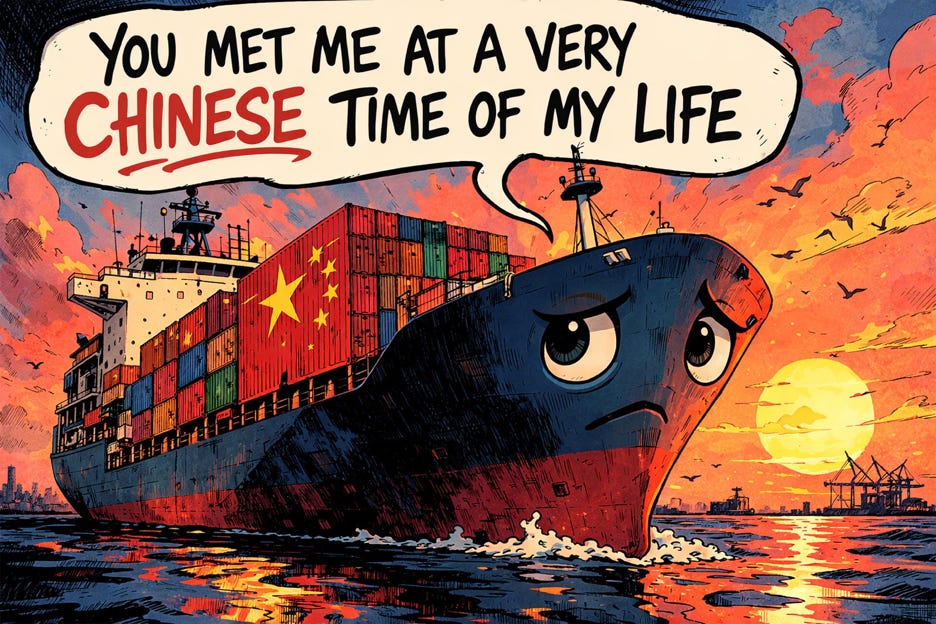
Rather than demonstrating the US ability to cut off China from Iranian oil, the conflict has seen the phenomenon of ships identifying themselves as Chinese in order to be granted safe passage through the strait.
Even if China ends up losing access to Iranian oil, this does not plunge it into a Cuba-style energy crisis owing to international isolation. China is a wealthy country that is heavily integrated into the world economy, it can simply buy oil and gas on the open market, as it does for most its supply. China also has access to Russian oil and gas, which it can purchase with RMB at advantageous rates, for which Russia has few other buyers.
The Iran War is setting off a global energy crisis which is affecting all nations, yet China may prove one of the most insulated, given its extensive reserves and its all-of-the-above energy approach, which includes coal, wind, solar, and nuclear. China also has deep pockets, and can more than easily outbid most other countries for dwindling global supplies.
What would even be the motivation for trying to cutoff China’s oil imports? The US is not at war with China, nor attempting to blockade it or impose economic sanctions. A sudden oil shortage will certainly will not cripple China’s immediate military readiness, as military needs will take priority over industrial ones.
Is this some 5D chess move to cripple China’s economic growth by limiting energy imports as the key input to China’s industrial production? This also makes little sense. If China faces a serious energy crunch that leads to a massive reduction in industrial capacity, the rest of the world, reliant on Chinese imports, would also be plunged into crisis. This experiment was carried out during the SARS-COV-2 pandemic, and resulted in global prices skyrocketing amidst shortages of essential goods.
Trump himself has also ruled out this theory, telling reporters that it would be an “honor” to keep the oil flowing to China.
What this will do is stress test China’s reliance on imported oil, allowing it to prepare well for an even bigger future shock, such as a full US blockade of Chinese energy imports via the Strait of Malacca, in the case of a war over Taiwan.
In practice, the US is shooting its shot early, weakening any future attempt to pressure China through an energy blockade.
The bottom line: China will weather the global energy crisis just fine, preparing it for future blockades.
Myth #4: Striking Iran intimidates China, deterring an attack on Taiwan
The idea that China is somehow intimidated by the full force of the United States military blasting away at a second-rate military power with a deeply impoverished economy and decrepit military equipment is quite frankly ludicrous. In reality, the Maotai glasses were clinking in Zhongnanhai when news broke of the US-Israeli attack on Iran.
Several versions of this argument have claimed that the US is demonstrating force it can bring against Beijing in a decapitation strike or to wipe out Beijing’s power projection capabilities. This is not a serious argument for two reasons: first of all, a decapitation strike against Beijing would almost certainly lead to retaliatory nuclear strikes against the United States. The world’s nuclear powers have prepared for decapitation scenarios for decades, and developed resilient second-strike capabilities to ensure deterrence through mutually-assured destruction.
More importantly: a nuclear-armed superpower bombing the daylights out of a second-rate regional power that barely has functional electricity and water supplies is the equivalent of a UFC fighter trying to intimidate a rival by beating up a schoolboy.
As one of my college professors used to say: “It’s Bambi versus Godzilla!”

The US and Israel, both nuclear powers with the world’s most advanced weaponry, are fighting as a tag team against a country they have weakened for years both military and economically. While it has sizable arsenals of ballistic missiles and attack drones, Iran’s Air Force—what’s left of it— is composed of a few dozen fighter-jets manufactured in the 1960s and Frankensteined into flying order.
That is all to say, none of this can meaningfully reflect what it would be like for the United States to fight against a peer competitor, one with nearly as advanced air and naval assets, cutting edge electronic warfare capabilities, the world’s largest conventional missile and drone arsenals, and a scale and industrial base unmatched by any.
Some have argued that the US demonstrating powerful new weapons in battle will intimidate China from trying to invade Taiwan. In reality, all the US is doing is revealing battle tactics and possibly even electronic stealth signatures, while expending munitions faster than it can replenish them.
None of this can meaningfully reflect what it would be like for the United States to fight against a peer competitor, one with nearly as advanced air and naval assets, cutting edge electronic warfare capabilities, the world’s largest conventional missile and drone arsenals, and a scale and industrial base unmatched by any.
Another repeated claim is that the US attacks on Venezuela and Iran have demonstrated that Russian and Chinese air defense systems do not work. However the evidence belies this, with a report from Domino Theory revealing that claims of Iran deploying or even taking delivery of China’s latest HQ-9B system are completely unsubstantiated. In terms of Russian equipment, reports are mixed whether or not Iran has any remaining S-300 systems, which are already two generations behind Russia’s latest air defense system, and analysts have claimed what air defense systems Iran has are poorly integrated.
And still, the Iranians have now been able to score the first ever successful hit on an F-35, the US’ most advanced stealth fighter.
Some of the strangest forms of this argument have claimed that the US demonstrating its willingness to use military force is itself a deterrent. This argument fails to consider that the US has not taken a break from using military force during the unipolar moment, with long forever wars in the Middle East, air and drone campaigns all over the world, and regime change operations from Libya to Syria. None of these were against great powers with nuclear deterrents. On the contrary, the US overextending itself and depleting resources in numerous wars and military operations around the globe reduces readiness on the Indo-Pacific and has made the American public weary of war and strongly opposed to overseas interventions.
The bottom line: Nuclear superpowers are not easily intimidated by lopsided smackdowns.
Why this war worries me in Taipei
Contrary to widespread fearmongering, China will not attempt to invade Taiwan in 2027. An amphibious operation across the 90-mile wide Taiwan Strait would be the most difficult military operation ever attempted in history, and done by a military that has not seen major combat in half a century. It would risk nuclear escalation with the United States, crater the global economy, and risk ending nearly 80 years of CCP rule in China.
The status quo remains stable because Taiwan, backed by the United States and Japan, retains sufficient deterrent power to ensure China will not attempt such risks.
The Iran War threatens to upend that status quo.
Every hour this war continues plunges America’s East Asian allies into years of vulnerabilities due to dwindling munitions that are being burned at rates far faster than the US and its allies are able to produce replacements. In the first six days of the war alone—which is now going into its fourth week— the US burned through over 300 Tomahawk missiles (TLAMs), which form the backbone of the US Navy’s cruise missile arsenal (they are also used by the Army in Typhon launchers, an increasingly essential land-based deterrent which the US has deployed in the Philippines).
Last year the US manufactured only 72 Tomahawks.
The ratios are similarly terrifying for THAAD interceptors and Patriot missiles, the latter of which are an essential part of Taiwan’s aerial defense strategy. Although there are plans to scale up production of all these systems, with targets of even 1000 Tomahawks per year, production does not scale easily and is rife with bottlenecks. Even worse, China’s stranglehold on rare earths threatens to hand China the production rate limits to the US’ own munition production.
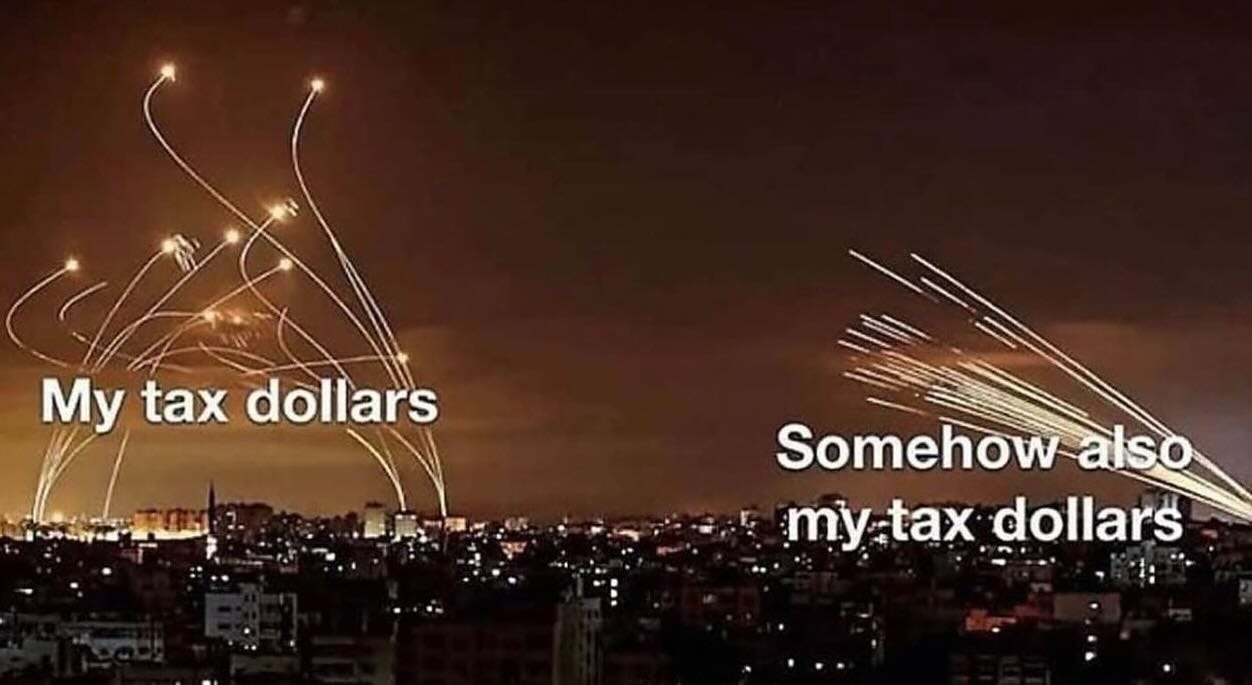
Every week the US and its allies continue to burn through munitions at an unsustainable rate, firing $4 million interceptor missiles to destroy $30,000 drones made in motorcycle shops.
The destruction of billion-dollar radar systems (namely the AN/FPS-132 and AN/TPS-59) by cheap, asymmetric, attritable systems puts Iran on the winning side of the cost-benefit ratio. Replacing these systems requires hundreds of kilograms of gallium, a rare-earth where China controls 99% of the world supply.
A 2023 analysis by CSIS estimated that in a conflict over Taiwan, the US would run out of precision munitions within a single week. That assessment came before years of arms transfers to Ukraine and Israel, the 2025 campaigns against the Houthis and Iran, strikes in Nigeria, the Caribbean & Eastern Pacific, Somalia, Syria, Iraq, and of course Venezuela and the current ongoing war with Iran.
During the First Cold War, the missile gap turned out to be a paranoid fiction. Today, it is rapidly becoming a reality.
This is before even getting into US-produced aircraft using US-produced air-to-air missiles to shoot each other down, resulting in the loss of three F-15Es, and KC-135 Stratotankers crashing into each other, with full crew and hull loss of one aircraft, and severe damage to another (Iran does claim that its militias in Iraq shot down the aircraft).
Then there is the matter of the US arms sales package which has been delayed until after Trump’s planned summit with Xi in Beijing. With the meeting now postponed indefinitely, the question of the arms sale is now also in limbo. Every delay not only sets back Taiwan’s preparedness, but also gives immense fuel to Taiwan’s US-skeptical political opposition to obstruct appropriations for arms sales.
Nobody knows how this war will end. But it will not end well for the United States. The United States has no clearly defined goals, and thus will be unable to achieve a clear victory. If the goal is regime change, this cannot be accomplished without a long and drawn out ground war, which Trump remains broadly opposed to. Iran is therefore currently winning this war by dint of maintaining regime survival and controlling the Strait of Hormuz. Should the United States make the fatal decision of entering a lengthy ground war, it has a pair of 20-year-long regime change wars in the region to base its predictions on. Should it attempt a more limited operation on Kharg Island, as is currently being speculated, it will prove to be Gallipoli, rather than Iwo Jima.
One long-term consequence of a devastating end to this vastly unpopular, senseless, and illegal war, will be a far-reaching backlash to foreign interventionism among the American people
One long-term consequence of a devastating end to this vastly unpopular, senseless, and illegal war, will be a far-reaching backlash to foreign interventionism among the American people. As American casualties continue to mount, so too will the backlash against this and future overseas interventions. With decreased appetite for war and a lack of trust in their leaders to be judicious on the use of force, Americans will choose increasingly restrained and even isolationist leaders. Future leaders on both the Left and the Right will be skeptical of entering into a foreign war, particularly one with costs as high as defending Taiwan, and attempts to do so may engender immense public backlash.
The Endgame
A quick end to this war will not necessarily solve any of these problems. Almost a year ago, the US and Israel declared victory after attacking Iran, and here we are in a protracted war with no clearly defined goals or definition of victory. The problem remains that the US may continue to follow Israel year after year into subsequent wars with Iran, expending munitions and shifting troops away from the Indo-Pacific.
While deterrence holds today and the balance of power still favors the status quo in the Taiwan Strait, this may not be true five years from now. It is not unlikely that the war ends soon, yet the US continues expending munitions in strikes against Iran and regional proxies such as the Houthis on a regular basis. Although Trump officials have stated that Taiwan is at the front of the delivery queue for weapons, it’s hard to imagine this will remain the case as Gulf allies seek to replenish missile stocks they have expended to defend American bases they host. With most of these states having transferred billions of dollars directly to the Trump family, they will most certainly seek to recoup those investments as Iran also rearms and retrenches.
A few years from now, it is easy to imagine a scenario where Iran’s new hardline leadership, having survived a brutal and devastating war, determines that a nuclear deterrent is the only path forward. Developing a nuclear device while rebuilding their drone and missile arsenals deep, deep underground, the US may once again follow Israel into war against Iran. This time, armed with advanced Russian and Chinese air defenses, and sheltered in deep mountain tunnels, Iran would require far more firepower to subdue than this current war, and risk incurring the loss of more allied aircraft.
As the US surges troops and weapons platforms out of the Indo-Pacific, it would quickly burn through already dangerously low munitions stocks. China, having spent the past years preparing for a disruption to Middle Eastern energy imports, producing missiles, drones, and ships at a breakneck pace, and enhancing its global standing, may assess that it has a unique window of opportunity to take Taiwan.
The US, embroiled in another unpopular Middle Eastern quagmire, may then calculate that it does not have sufficient capabilities to stop China’s attack, and choose not to respond, or it may simply lose the war altogether, outgunned and outmatched in the region.
There is no endgame because this is not 5D chess. It’s bughouse, and every piece the US loses in one theater is handing China an advantage in another.
Why I’m Still Hopeful
Despite all the grim developments, there are still rays of hope for Taiwan. Despite Taiwan’s much recent rhetoric about needing to model itself after Israel, it has a lot more to learn from Iran.
Rather than investing a third of its special defense budget on a “T-Dome” air defense system based on an increasingly outdated concept, Taiwan should look to Iran’s “Mosaic Doctrine” of decentralized defense. Iran has survived continuous decapitation strikes, decentralized command and control to maintain increasingly effective retaliatory capabilities, and successfully deterred the US Navy from attempting amphibious attacks through anti-access/area denial (A2AD) capabilities in the Persian Gulf. It has done all of this with essentially no Navy, no Air Force, and on the cheap, using attritable munitions mass-produced for $30,000 a piece to deter and destroy systems costing hundreds of millions.
For Taiwan, those are the critical elements it needs to master in order to survive a Chinese first strike and deter an amphibious invasion.
There are signs Taiwanese officials are wising to the problem. Despite initially foolhardy comments from the Foreign Ministry welcoming the war (which began with the killing of over 170 schoolgirls in a US strike on an elementary school) for helping the Iranian people to “enjoy freedom, democracy and human rights,” Taiwanese security officials are now leaking concerns about protracted war to international media, observing that the unsustainable attrition of munitions is actively eroding deterrence in the Taiwan strait.
The Lai administration’s move to restart nuclear power is an important first step towards energy security, and recent investments in the domestic drone industry lay the groundwork for enhancing Taiwan’s deterrence capabilities. Recent polling data indicates that a majority of Taiwanese are willing to fight for their country even if the US does not come to their aid.
Still, it is unlikely Taiwan can effectively deter China without a credible US security deterrent. It remains to be seen if Taiwan can become a porcupine faster than the US can hollow out its own arsenals. The urgency is now stronger than it has ever been.
The cost of this war will be borne chiefly by the Iranian people, but it may ultimately cost the Taiwanese as well.