

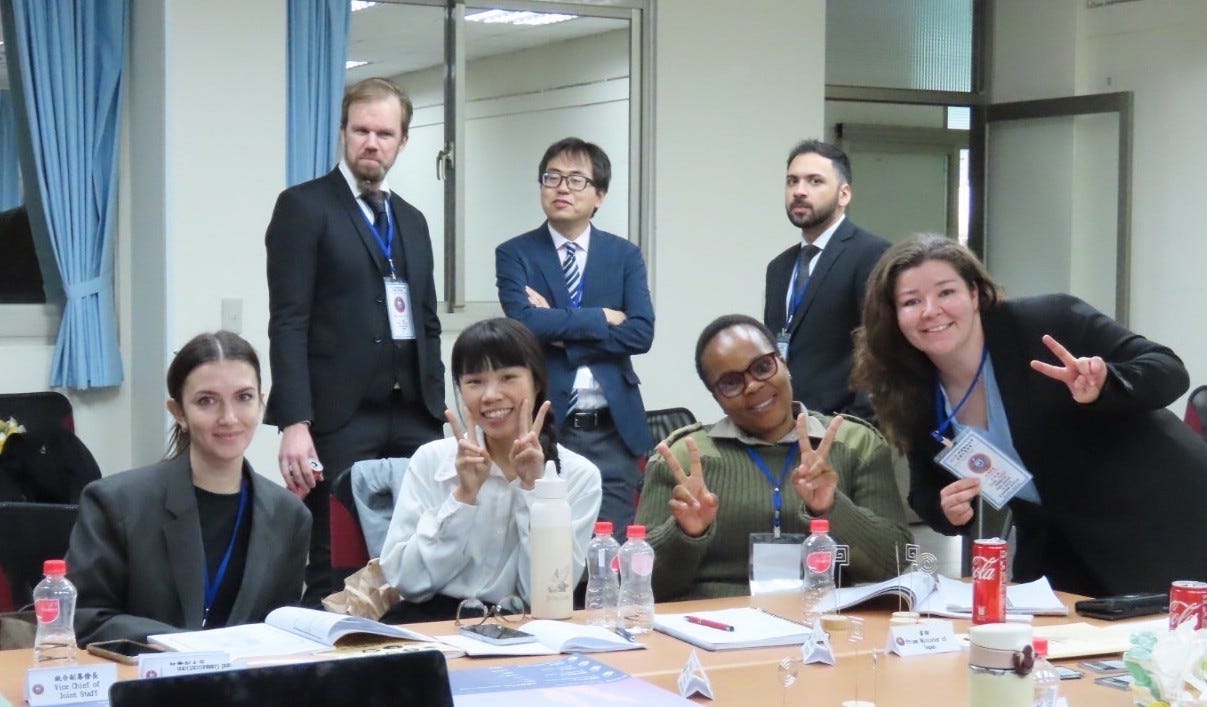
Earlier this month I was invited to join National Defense University‘s annual International Civilian & Military Joint Crisis Game as an instructor. As an advisor to the Japanese team, along with distinguished colleagues Masatoshi Murakami and Matti Puranen (seen below reacting dramatically alongside me to China’s menacing of the Senkaku Islands) I was able to share my experiences with wargaming and the regional security situation with a diverse team of bright students from Taiwan and around the world.
Recent remarks by Prime Minister Takaichi remind us that despite a Taiwan contingency being a “survival threatening situation” for Japan, the role of Japan is a difficult one, given that it will not be the main driver of either initiating or responding to war in the Taiwan strait.
That being said, Japan has immense agency, and Japanese strategists would do well to consider the following takeaways from our simulation, which incorporated advanced AI decision-making platforms:
Japan must work hand-in-glove with its allies, the United States and Taiwan, to mount an effective deterrence strategy, and should that fail, a winning battle plan against China along the First Island Chain. The US’ newly released 2025 National Security Strategy reflects this in its call for Japan and South Korea to “increase defense spending, with a focus on [new] capabilities— necessary to deter adversaries and protect the First Island Chain.” I predict that, as in our simulation, Korea will not be particularly interested in risking attacks on the homeland to protect allies in the First Island Chain, unlike Japan. China’s sanctioning today of Shigeru Iwasaki, Japan’s highest-ranking military officer, who is now advising Taiwan’s Executive Yuan, indicates that China is extremely afraid of deeper and closer coordination between Japan and Taiwan, who are already “Geopolitical BFFs.”
Dual-use infrastructure, particularly in Okinawa and the Ryukyus, was essential to mounting an effective defense of Taiwan. Runways in the region place the Taiwan Strait within the combat radius of JASDF and US fighter aircraft, allowing allied forces to respond within minutes to Chinese aggression and run continuous sorties. Increasing the number of available runways and combat infrastructure in these islands enhances deterrence through survivability, which in turn reduces the possibility of armed conflict. An early deployment of intermediate range missiles to the Yaeyama islands is a critical signal to the Chinese that any attempt to use force against Taiwan will be met with lethal Allied resistance.
One of the most important investments Japan has made in recent months is committing to invest $3-500 million in undersea cable repair ships. Prior to the breakout of conflict, China initiated grayzone operations to sever undersea cables not merely around Taiwan, but also those connecting Taiwan and vital Pacific Islands to the rest of the world. Japan, like Taiwan, remains heavily dependent on undersea cables for secure communications with its allies, and breaks in this network are intended to delay and distort information sharing during a crisis.
A critical conceptual understanding of the famous 台灣有事就是日本有事 “a Taiwan contingency is a Japan contingency” statement is that China’s playbook against Taiwan is also intended for use against Japan— specifically in Okinawa, which would be rendered indefensible by the fall of Taiwan. China’s spreading of disinformation around historical claims, its use of power projection to simulate blockade or interdiction capabilities, and ability to sever critical communications infrastructure is a playbook it has been developing for Taiwan and now is extending further into the East and South China Seas. Indeed, Japan should understand that 台灣有事就是沖繩有事, a Taiwan contingency presents an existential Okinawa contingency.
Deploying effective countermeasures to protect Taiwan will be essential for the defense of Japan, the Philippines, and Pacific Island states (including the US territory of Guam), which are all highly vulnerable to these measures. Effective war game simulations will take these factors into account, and should include relevant teams from those countries, and prepare localized AAR (after-action review) to prepare regional strategists and officials.