

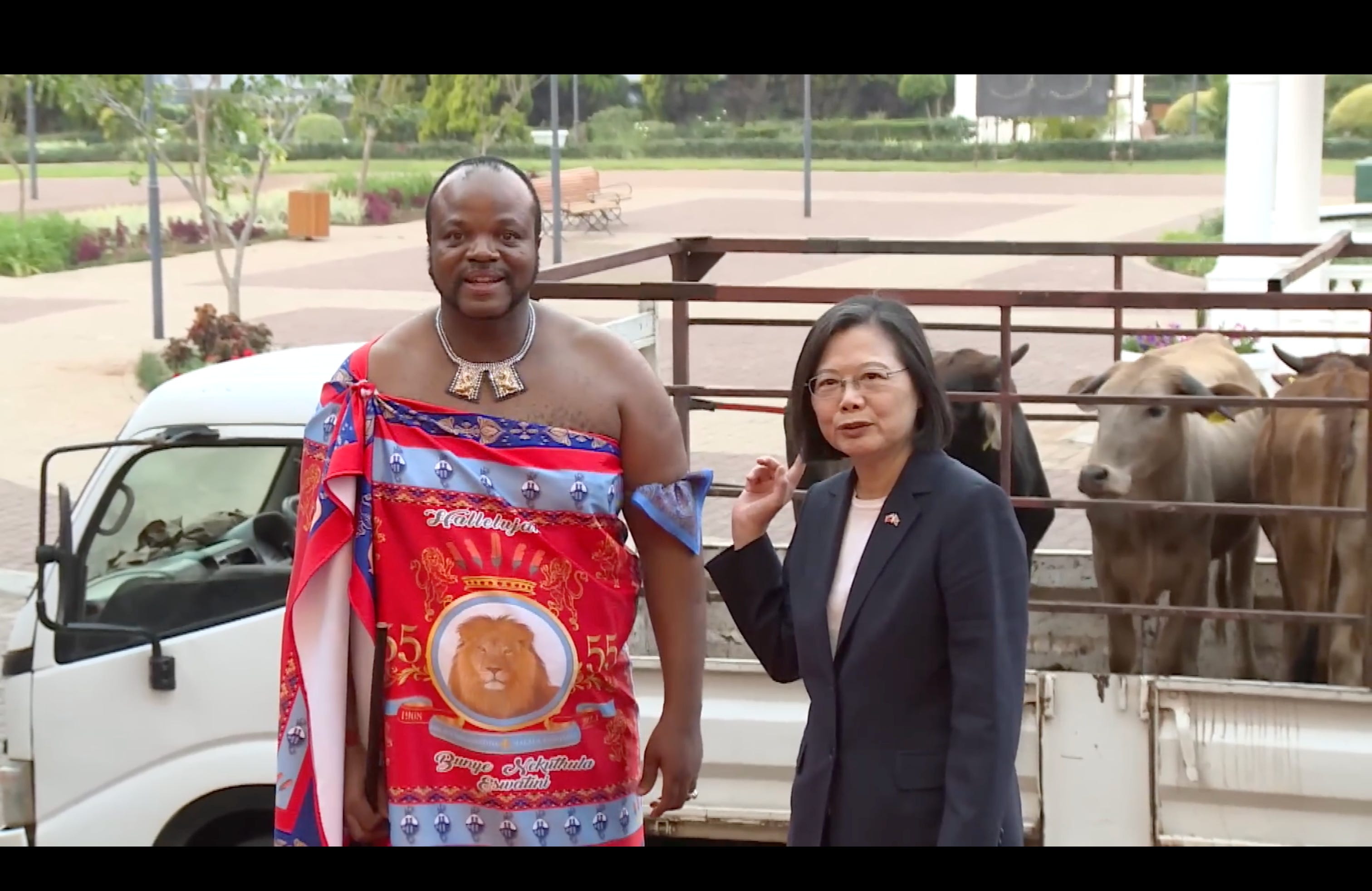
There are few regimes more vile, more oppressive, and more loathsome than the murderous regime of Africa’s last absolute monarch: King Mswati III of Eswatini, a notorious child predator who tortures and murders dissidents and drives diamond-encrusted Maybachs while half his country lives in abject poverty. He once fined himself a cow for taking a child bride after ostensibly outlawing the practice.
Taiwan calls him an ally.
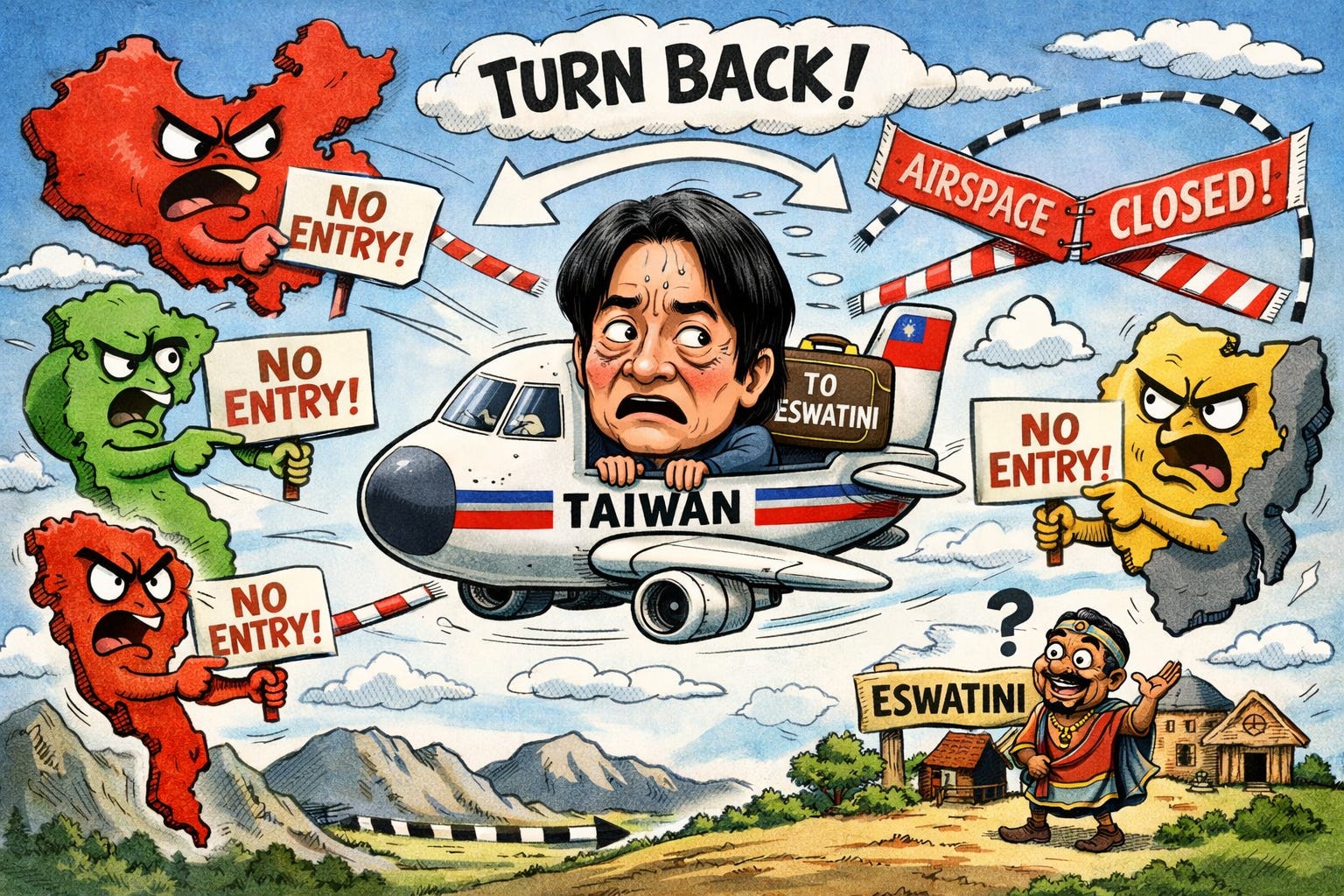
In fact, Taiwanese taxpayers are underwriting the whole operation. Taiwan’s relationship with the despotic hermit kingdom has come to the forefront this week as China blocked President William Lai Ching-te’s attempt to visit Eswatini (also known as Swaziland) for King Mswati’s birthday party by pressuring the governments of the Seychelles, Madagascar, and Mauritius to deny airspace overflight rights to Taiwan.
Taipei has protested and the political establishment is up in arms here, but China may have just done Taiwan a favor. The relationship with Eswatini accomplishes nothing for Taiwan, is incredibly damaging to Taiwan’s reputation and values, and severely undermines Taiwan’s very legitimate claims to sovereignty and statehood.
Africa’s Epstein: A stain on Taiwan’s reputation
Despite claiming to have a foreign policy rooted in “democracy” and “values-based diplomacy,” Taiwan’s government enables the most despotic and tyrannical regime in Africa, bribing the mad king with private jets which he uses to fly to Taiwan for free healthcare while ruling over the world’s most HIV-positive population. Instead of providing his people with lifesaving antiretroviral medications, or food for their hungry mouths, he throws multi-million dollar birthday parties subsidized by the Taiwanese government, most of which goes towards luxury car purchases.
The tyrant’s abuses have been well-known for decades, and by all accounts he is quite proud of his despotic antics. To recount just a small summary of his disgusting, deplorable, and dictatorial behavior: King Mswati III has murdered pro-democracy activists in cold blood, including beyond Eswatini’s borders, orchestrated the mass shooting of student protestors, banned political parties, kidnapped and tortured local and foreign journalists, and kidnapped and raped girls in forced “marriages” in a disgusting yearly ritual known as the “reed dance.”
The last point bears further discussion and has long gripped the international community. In custom he largely invented, all virgin girls in the kingdom from ages 11-17 are forced to attend a ceremony and parade naked before the king and his entourage, who then kidnap selected girls for impregnation by the king, after which they join his harem of abused “wives.” These girls are abducted, forced to drop out of grade school, and then imprisoned in his palaces.
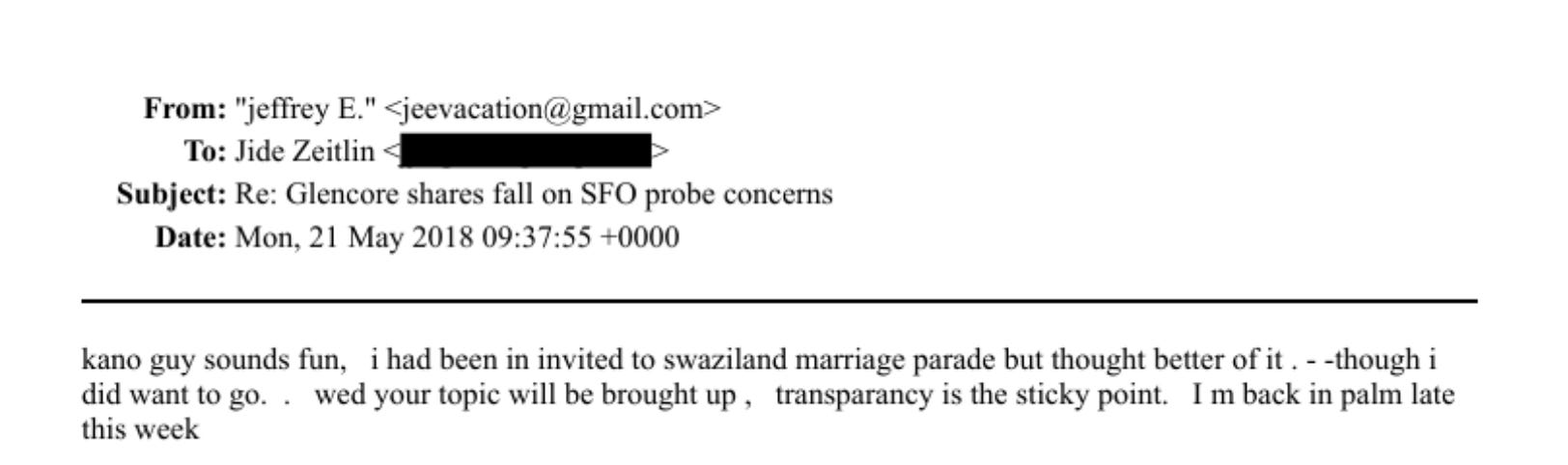
The practice is so universally despised and revolting that even Jeffrey Epstein thought it would a bridge too far to attend, though he did “want to go,” as expressed in an email to Jide Zeitlin, then-chair of Nigeria’s sovereign wealth fund and former Goldman Sachs partner:
“i had been in invited to swaziland marriage parade but thought better of it . - -though i did want to go. .”
-Jeffrey Epstein, May 2018
Mswati himself fits the bill as “Africa’s Epstein,” flying his harem of underage girls around on a Taiwanese “Lolita Express.”
Is it “values-based diplomacy” to support this? Why exactly does the Taiwanese president want to appear so badly with someone so unsavory that even Jeffrey Epstein didn’t want to be seen with him?
Taiwan’s direct involvement in abuses against the Swazi people has been revealed this week in a damning exposé by Taiwan-based investigative journalist James Baron, whose groundbreaking report The Ugly Side of Eswatini-Taiwan Relations, has exposed grave abuses by Taiwanese government-funded organizations in the autocratic kingdom.
The report is worth a read in full for the litany of abuses, funded by Taiwanese taxpayers, but include allegations of Taiwanese food security officials literally snatching food from the mouths of starving local workers, racism and segregation, the hiring of kung-fu teachers with a known history of child abuse, threats of reporting employees who raised concerns about such abuses to local authorities, and using so-called “disinformation experts” to train Eswatini authorities in censoring local pro-democracy activists on social media.
In response to these allegations, instead of taking great concern for human rights and the potential abuse of taxpayer funding, Taiwan’s foreign ministry has instead responded with false and defamatory attacks on Baron’s credibility—in ways that legal experts in Taiwan have suggested may be libelous. James is a thoroughly credible reporter who not only has lived in Taiwan for decades, but has actually worked in Taiwan’s overseas development assistance institutions, and is deeply sourced within the country. Many brave Eswatini citizens literally put their lives on the line to talk to him, knowing they might face torture or certain death.
The entire report is scandalous and bears reading in full, but a few choice excerpts have stood out.
According to the report, Taiwan’s Amitofo Care Center relocated teachers to Eswatini from Malawi who had been removed following a report in The Economist last year documenting how they beat students to the point of breaking their bones and used orphans in wildlife tracking. In Eswatini, their abuse of orphans continued, according to two local teachers who confronted the foreign teachers upon seeing them physically abusing students:
Two kung fu coaches hurt the children they were training so badly that they had broken arms and were sent to Nhlangano health center.
The two teachers cited genuine fears for their own safety and that of their families for their decision to remain anonymous. “Critics here can just disappear without a trace, and nobody cares,” said the second teacher.
Eswatini is also a country that suffers from severe malnutrition, which Taiwan is allegedly supposed to be addressing through the Taiwan-Africa Vegetable Initiative (TAVI), yet:
Swazi employees of TAVI report routinely going hungry while carrying out their duties, with Taiwanese management forcing them to go without food for protracted periods.
In one incident in October 2025, food was snatched from a TAVI employee by a Taiwanese project manager in front of Swazi legislators attending an event for one of these projects at a primary school in Eswatini’s capital of Mbabane.
Such incidents are widely known in Eswatini, yet local media is unable to report on them due to the tendency of the regime to murder journalists. As a result, most scandalous news is reported from outlets located in neighboring South Africa, home to a majority of the Swazi people, and Eswatini’s democratic opposition. King Mswati and the Taiwanese government claim that opposition media and politicians are funded by China, and while no evidence has ever been presented of a funding arrangement, who can blame them? If Taiwan were funding the abuse and rape of your countrymen, no one would blame you for taking Chinese funding.
Yet Taiwan’s response has been to use taxpayer funds to send supposed “NGOs” to Eswatini to help with the suppression of news stories critical of the child rapist King and his tyrannical rule, many of which were written by dissident Zweli Martin Dlamini, who has been accused of taking Chinese funding:
Taiwan’s Foreign Minister Lin Chia-lung joined his counterpart Pholile Shakantu in signing the MoU, with a stated aim of combating disinformation in the country.
Dlamini’s contention that the agreement, which allegedly provided over $610,000 in funding, was designed to stifle dissent and was specifically aimed at Swaziland News chimes with an account of a four-day cybersecurity workshop run by Taiwan Digital Diplomacy Association (TDDA) in Eswatini in December 2025, with support from MOFA.
“Everyone was mentioning him, there,” said Samuel Straw, head of research at TDDA, referring to Dlamini. “They were very direct, saying that he was posting fake news, funded by China, and causing issues for them.”
While Straw said the participants framed their questions carefully, the import was clear: “Essentially, they wanted the tools and knowledge to take down Facebook posts criticizing the government.”
Best case practices from the European Union in tackling Russian propaganda were shared, said Straw. “But in Eswatini’s case, it is against anti-government protesters. And who decides what is misinformation? The authorities, right?”
What has been shocking has been not just the Taiwanese government’s choice to respond to these serious allegations by defaming the widely-respect journalist and news outlet behind the independent reporting, which unfortunately is expected behavior at this point, but the role of activist NGOs such as TDDA, which brands itself as an independent pro-democracy organization, in continuing the slander.
In a remarkable turn of events, after sharing James’ article on my public social media accounts—as I often do with articles I find important—I received a vaguely threatening email from the TDDA, claiming that my sharing of the article critical of King Mswati was personally endangering their staff, and demanding I apologize for sharing a news article on social media in a democratic country.
The Taiwan Digital Diplomacy Association should spend less time attacking journalists and more time reflecting on the fact that they did PR training for the Jeffrey Epstein of Africa.
These incidents are not only stomach-churning in their own right, but they are insulting to the generations of Taiwanese who fought so hard for the rights of freedom, democracy, expression, and belief against the brutal regime of the Kuomintang under martial law. In a period known as “White Terror,” democracy activists were disappeared, tortured, and executed, political parties were banned, independent media were censored, and a cult of personality was enforced around the tyrannical dictator Chiang Kai-shek.
This would be a familiar story to anyone living under the tyrannical regime in Eswatini.
The Democratic Progressive Party of President Lai was founded directly in opposition to all of these things. The founders of the DPP faced imprisonment and torture for opposing the Chiang party-state regime, and tens of thousands of Taiwanese were murdered for their identity or beliefs. Yet all three DPP presidents have upheld the ROC policies of propping up a dictator guilty of the very crimes their political movement was founded against, all in the name of protecting the Republic of China government, in whose name the same abuses were carried out against the Taiwanese people.
Who defines sovereignty?
Taiwan should not mortgage its sovereignty to a club of countries and pseudo-countries with tenuous claims of sovereignty of their own.
To take on the moral guilt and responsibility of supporting such a despotic and rapacious regime, Taiwan would have to be gaining some extraordinary security or other vital national interests. Although frequently referred to as an “ally” by government officials, newspapers, scholars and analysts alike, no one can actually point to any single thing the diplomatic relationship with Eswatini accomplishes for Taiwan.
The fact that the autocratic fiefdom of Eswatini recognizes the existence of the Republic of China does absolutely nothing to protect Taiwan or advance Taiwanese interests. In fact, all it does is keep alive the “one China” myth that Beijing is seeking to advance around the world, and which most Taiwanese reject. The relationship, along with the handful of other microstates and non-state entities that recognize the Republic of China, is a relic of an era when the People’s Republic of China and Republic of China competed around the world for recognition as the one true China. The PRC has clearly won that competition by now, and it is a competition the people of Taiwan, who do not identify as Chinese, have no interest in continuing.
Maintaining the “one China” myth only makes Taiwan look fundamentally unserious and promotes a false narrative that Taiwan is part of China and the Taiwanese people would like to “unite” with China. This is not a narrative that will build long-term support in countries that actually matter to Taiwan’s security, in fact it pushes those countries to view Taiwan’s preferred future as unifying with China.
The fact that the autocratic fiefdom of Eswatini recognizes the existence of the Republic of China does absolutely nothing to protect Taiwan or advance Taiwanese interests.
Ironically, it is China that is working hard to dispel the one China myth and break the so-called 1992 consensus. In a regular press conference this week, China’s foreign ministry spokesperson Guo Jiakun stated: “It’s very clear that there’s no longer a so-called “ROC president” in the world anymore. Anyone who wears that false title is acting against history and will only invite disgrace upon themselves.”
If there is no ROC president anymore, then what does that leave? Just Taiwan, an independent state unassociated with China. In its unfinished campaign to derecognize the ROC, China has not grappled what will happen once the ROC is fully derecognized. Taipei’s diplomatic relationships with countries recognizing the ROC only aid Beijing’s narrative warfare.
Taiwan is indisputably an independent sovereign state with its own government, military, laws, and full control of its own borders. Its permanent population elects its own government, and it engages in foreign and commercial relations with other states. It issues passports and visas, assesses customs duties, levies taxes, and enforces its own laws, sometimes brutally. There is no higher authority on Taiwan, Penghu, Kinmen, and Matsu than the government of Taiwan (ROC). Under the Montevideo Convention, Taiwan meets all the necessary conditions for statehood, possessing a permanent population, defined territory, a government, and the capacity to enter into relations with other states.
Although Taiwan’s government asserts its sovereignty under the Montevideo Convention, the declarative theory of statehood, it is unclear why it directs so much of its foreign policy towards advancing the constitutive theory of statehood, which defines statehood in terms of recognition by other states. The Montevideo Convention not only clearly defines that “the political existence of the state is independent of recognition by the other states,” but makes it clear that “recognition of a state may be express or tacit,” which indeed comprises the majority of Taiwan’s foreign relations.
Taiwan is indisputably an independent sovereign state with its own government, military, laws, and full control of its own borders.
Taiwan is faced with a choice: embracing the obviousness and reality of its sovereign existence as a Taiwanese state, or reducing itself to a rump Republic of China government with fantastical claims to sovereignty over China and Mongolia.
Taiwan says “look we’re a real country” and then presents as evidence is a series of tortured statements from the likes of Eswatini and St. Lucia, countries no one has ever heard of, or Palau and the Marshall Islands, which are functionally US overseas territories, or the Holy See, which is not only not even a country, but does not actually maintain diplomatic relations with Taiwan, having not sent an ambassador to Taiwan since the 1971 expulsion of the ROC from the United Nations. The Vatican has also consistently denied entry to the Taiwanese president, foreign minister, and all high-level government officials for the past decade.
Taiwan should not mortgage its sovereignty to a club of countries and pseudo-countries with tenuous claims of sovereignty of their own.
When the Taiwanese president attempts to legitimate his rule by crossing an ocean to present himself before an absolute monarch clad in animal hides, lavishing him with expensive gifts in return for designation as a sovereign, he looks like a Ryukyuan tributary ruler crossing the sea to kowtow before a Manchu emperor in return for legitimation as a subordinate ruler, and less like the democratically elected leader of a sovereign state heading one of the world’s major economies.
Does anyone seriously think that what the King of Eswatini says has any bearing on China’s claims to Taiwan or the United States’ determination to help Taiwan defend itself against China?
Taiwan’s foreign ministry is still stuck in the ROC era, paralyzed by the looming fear of complete derecognition. Yet it has nothing to fear, the constitutive theory of statehood is based on fantasy, and the declarative theory is simply a reflection of reality. If Eswatini or any other country no longer recognizes the ROC, no change will come to Taiwan’s continued sovereign ability to control its own territory. Honduras or Panama switching back to recognizing the ROC will do nothing to temper Beijing’s determination to claim Taiwan as its own.
Look no further than the pitiful situation of Palestine. Recognized now by nearly the entirety of the world, it still has no sovereign control of its own territory.
The trip has been embarrassing since before it even started. In advance of the trip, Taiwan’s foreign ministry lauded “40 African leaders” who offered their public support for Lai’s visit, yet did not dare to name a single one, or produce any evidence these leaders actually existed. If they existed at all, they appear to be backbencher IPAC types with little influence over their own countries’ foreign policy. The blocking of the trip has made it clear just how little influence Taiwan has in Africa.
The only public support Taiwan’s foreign ministry saw fit to publicize itself was a tweet by the unrecognized Republic of Somaliland (another Epstein favorite), leading Taiwanese officials and legislators to salivate over the inclusion of the ROC flag in the tweet.
What does Taiwan actually gain from Eswatini?
Taiwan gains literally nothing from its diplomatic relationship with Eswatini. In numerous engagements over the years with Taiwanese officials, I have never once been able to get any of them to explain what is actually concretely gained by any of these diplomatic partnerships. Without fail, platitudes are restated about the importance of the “advocacy” these countries do for Taiwan, which largely consists of brief speeches made at meetings of international organizations such as the UN and International Civil Aviation Organization (ICAO) about the importance of including Taiwan, after which Taiwan invariably loses whatever vote is put forward.
In light of this situation, Formosa Review is issuing a public challenge: if anyone is able to produce evidence of something concrete that Eswatini provides that directly enhances Taiwan’s security and national interests, Formosa Review will provide a prize of $1000. Examples of concrete support for Taiwanese interests include the provision of advanced weaponry, commitments to Taiwan’s military defense, direct pressure exerted on China to maintain the status quo, or successfully convincing other nations to support Taiwan as well.
Eswatini’s supposed “advocacy” in the ICAO has been powerless to stop ICAO member-states from closing their airspace to Taiwan’s president. This supposed “advocacy” in fact does not even exist, Eswatini’s foreign ministry has lodged no complaints nor made any public statements over its neighbors’ aggressive moves to blockade access to the landlocked nation. In fact, Eswatini does not even have permanent diplomatic missions to most of those international organizations it claims to advocate for Taiwan in.
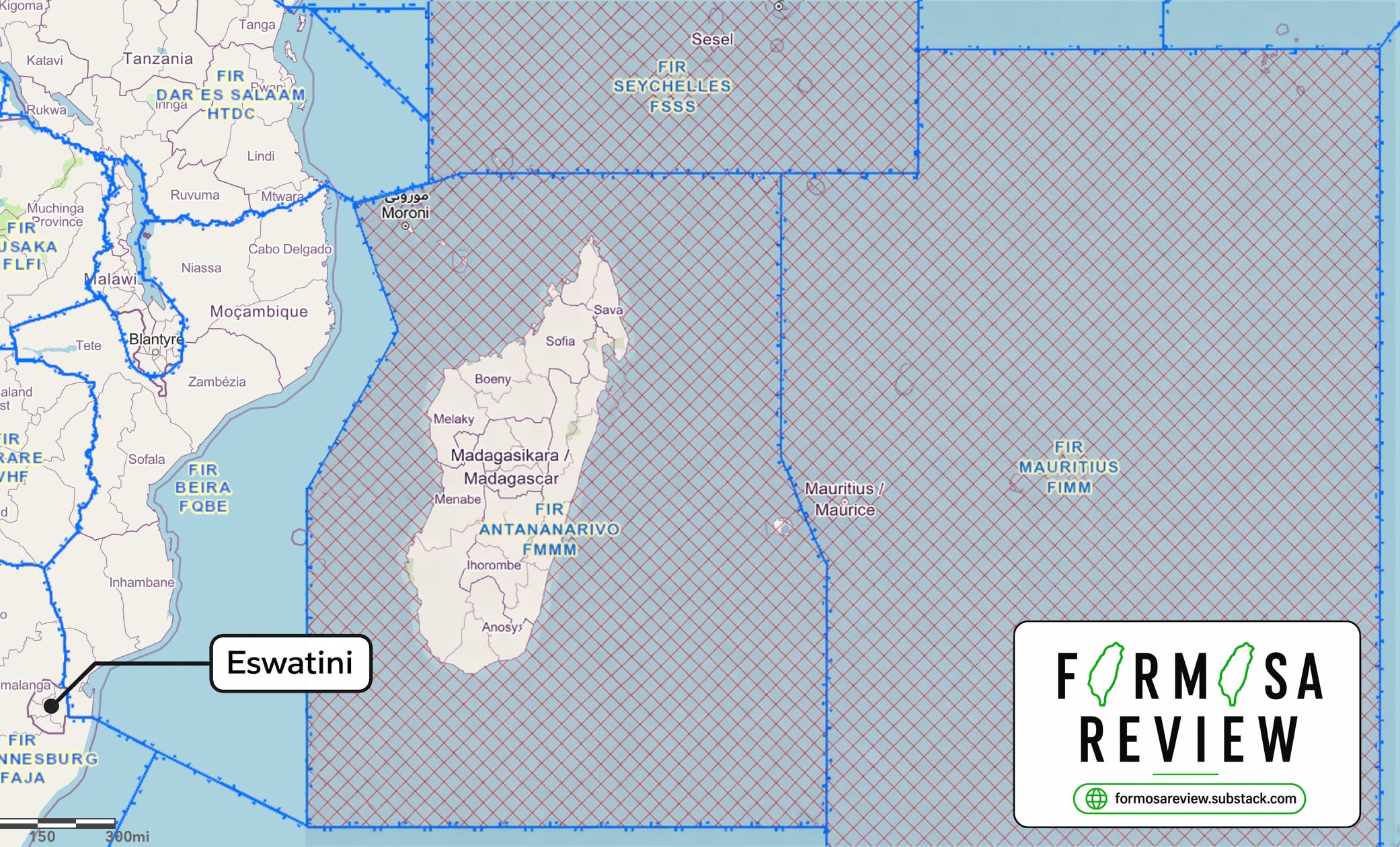
Instead, it has been Taiwan’s true allies, the US, Japan, UK, and EU countries that have protested the incident and advocated for Taiwan. Formosa Review can also confirm that several of these countries directly made diplomatic protests to the governments of the Seychelles, Mauritius, and Madagascar through their resident ambassadors. Eswatini does not even have embassies in any of those countries, nor do they have embassies in Eswatini, or even non-resident embassies in neighboring South Africa or Moçambique. Taiwan is relying on a country for diplomatic relations that itself has a more limited diplomatic presence than Taiwan does.
There is of course, a great irony here, while the US has protested the denial of transit by the Seychelles, Mauritius, and Madagascar, it itself denied transit permission to President Lai last summer, in order to smooth relations over with China. The situations are not identical, but for a more relevant comparison, it is undeniable the US established precedent for this sort of bullying behavior in 2013 when it pressured European allies to deny airspace transit to the aircraft of Bolivian president Evo Morales, forcing his plane down in Vienna, on groundless suspicions that NSA whistleblower Edward Snowden was on-board.
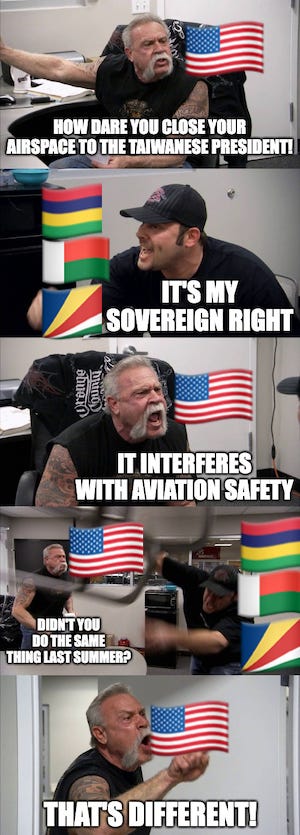
These rules only work when they apply to everyone. For all their bluster about China breaking the international order, the US and its allies shoulder quite a bit of responsibility themselves. That order is quickly collapsing under its inherent contradictions; what may replace it is as of yet uncertain, but it was an order that in any event never once had any respect for the self-determination of the Taiwanese people.
Where does Taiwan go from here?
The Taiwanese people struggled for democracy against a brutal dictatorship that brooked no dissent, murdering dissidents and muzzling the people it ruled over. The long Taiwanese fight for freedom and self-determination over hundreds of years of foreign or autocratic rule is one of the world’s most inspiring and compelling national stories.
To deny those same freedoms and rights to the emaSwati people in the name of Taiwan is a gross perversion.
Continuing the diplomatic relationship is not good for Taiwan and not good for Eswatini. It is time for continued subsidies to the tyrannical child rapist to end.
I am not advocating an immediate unilateral break in relations, but there is little doubt that downgrading the relationship will push Eswatini to seek ties instead with Beijing. This is fine, and reflects that the relationship has no depth or sincerity, but is simply transactional.
If the relationship persists, when the people of Eswatini finally rise up and hang their mad king for his crimes, the new regime will surely immediately sever ties with Taiwan and open relations with China.
And who can blame them? It is Taiwan that has polished the boot on their necks.
When that day comes, literally nothing will change in Taiwan’s security or status. Taiwan will remain sovereign and independent, and that independence will remain guarded by Taiwan’s own people, its military, and its true allies: the United States and Japan.