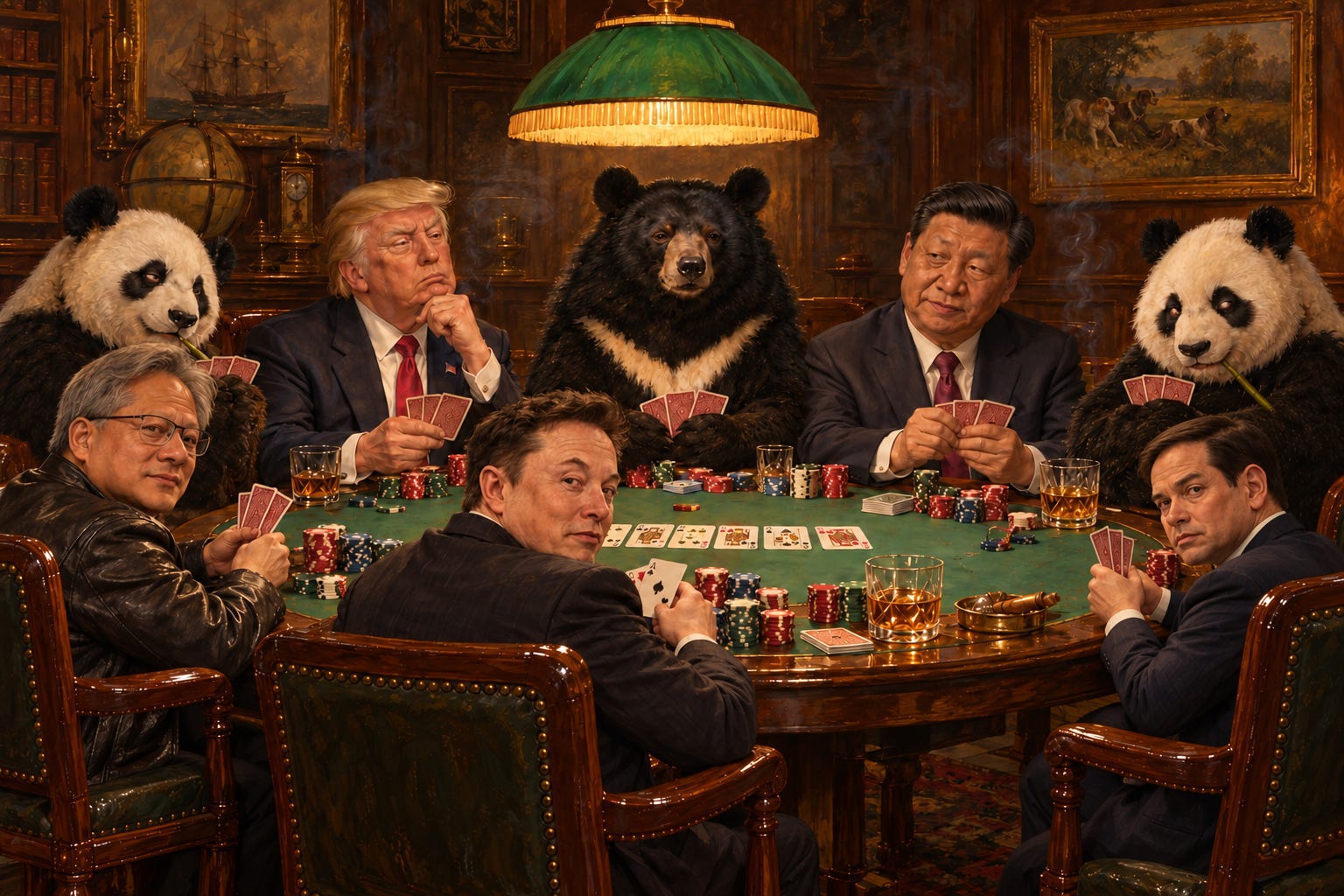
The second Trump-Xi summit seems to have wrapped up with no clear deliverables on any of the major issues at hand, whether AI safety, trade barriers, or of course, Taiwan. Many are taking this to mean that no news is good news, but no news in this case means no news of the still-pending $14 billion arms sale to Taiwan. As I wrote following the previous summit in Beijing, Xi is likely to continue laying carrots out for Trump to keep the arms sale pending as long as possible. The announcement that Trump will attend the upcoming APEC meeting in Shenzhen this November, followed by Xi attending the G20 in Florida this December, lays out two more carrots for Xi to dangle and threaten to takeaway if the arms sale materializes.
There is no chance of the arms sale materializing this year.
While many expect the arms sale to eventually come through at the end of Trump’s final term, as many of his predecessors have done, this delay may still be enough to impact Taiwan’s upcoming presidential election in January 2028, which is exactly what Xi is hoping to accomplish.
A key element of China’s cognitive warfare against Taiwan is to convince Taiwanese voters that America is an unreliable ally that will ultimately not come to their defense, and their only hope at avoiding devastating war is to elect a KMT president who will surrender to China on more favorable terms. I think the first part of this has been accomplished, largely through America’s own actions, but the result has not convinced Taiwanese voters that China is a more trustworthy partner: while only a third of Taiwanese voters believe the US is trustworthy, less than half of that number trust China.
It seems the only deliverable that has actually come out of this summit is the literal physical delivery of two new pandas to the Atlanta Zoo, making this as good a time as any to revisit a letter I published in the Washington Post two years ago about the arrival of new pandas for the Smithsonian Zoo.
In the letter, which was named one of the best letters of 2024, I observed that the new pandas had strange Mandarin names (Baoli and Qingbao), which sounded suspiciously like “violence” and “intelligence report,” the sort of puns that Chinese bureaucrats aiming to knock America down a peg relish in.
This year’s ursine delivery doesn’t appear to have the same dual meanings… or does it?
According to media reports, the pandas are named Pingping (平平) and Fushuang (福雙), which could be translated as something like “peaceful” and “double blessings.”
No dual meanings here? Almost. 平平 is a cute name, but in ordinary speech means “average” or “unremarkable,” even “mediocre” in some contexts. 福雙 on the face of it doesn’t appear to have any hidden meanings, but it strongly recalls the chengyu 福無雙至 (fuwushuangzhi), a four-character Chinese idiom that means: “blessings never come in pairs.”
Interesting phrase to recall when sending a gift that comes as a pair.
Below is my October 2024 letter to the Post:
D.C.’s new pandas are named what, now?
Depending on how they are pronounced, Bao Li and Qing Bao’s names have unsettling meanings.
As a former Washington resident and lifelong panda observer, I followed with keen interest in this black-and-white paper the return of our black-and-white, four-pawed friends. Though the Smithsonian’s National Zoo is a far cry from the Chengdu Research Base of Giant Panda Breeding, it is a cute and delightful corner of our nation’s capital.
Of course, as a Mandarin speaker, I could not help but smile as I read the names of our new Sichuanese immigrants: Bao Li and Qing Bao. How thoughtful of our friends across the Pacific to have given these bears monikers that can translate to “violence” and “intelligence report.” These names are truly fitting for these temporary visitors from China to our leafy capital city.
One wonders if the slight from Beijing is but a gentle mocking jest, a rude gesture that has gone unnoticed because of the lamentable decline in Chinese literacy these days in Washington.
Nonetheless, I will dutifully parade in front of these ursine visitors to watch them laze and dawdle through their daily routines. But how nice would it have been to instead welcome a pair of delightful Formosan black bears, with their protuberant snouts and lunar markings?