

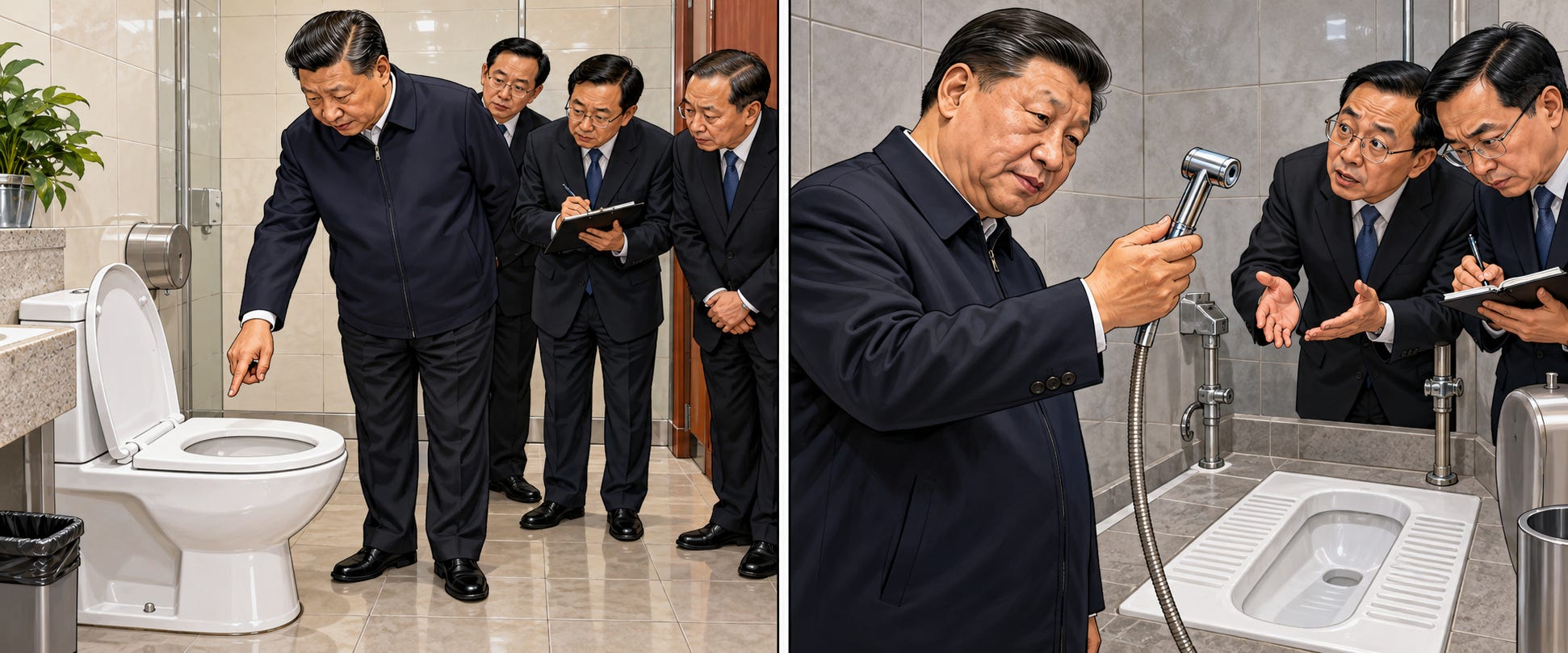
Chinese Foreign Ministry Spokesperson Mao Ning made history this week as the first Chinese MFA official to discuss toilets at a press conference, when she responded to a question about new White House Press Secretary Katie Zacharia’s comments that China could not overtake the US because “China didn’t even have proper toilets” when she lived there in 2013.
Mao’s terse response was to invite Zacharia to visit China again (presumably to use a toilet), something she should have time to do now, seeing as she was fired a few hours later.
There’s much to laugh about in these scatological press conference debates, but there is actually a lot you can learn about a country from its toilets. I first started spending time in China around the same time Zacharia lived there, in 2013, and spent a good part of the 2010s in China, including a few years living there full time. Throughout the seven or eight years I spent regularly traveling in China, I got to observe a great deal of changes and variations in Chinese toilet culture, which differed vastly across different regions, and evolved extensively over those years.
These changes reflected not just levels of development, but also changing social and hygiene norms as well as technological and even political trends in China. Everyone has heard about squat toilets versus sitting toilets, but the full scope and variation of toilets across China and the region is far more complicated than that.
My first apartment in China was a subdivided studio of questionable legality in a converted traditional lane-house or shikumen (石庫門). Built in 1936 concessional Shanghai, the lane house was not designed for conversion to individual apartments. This meant that indoor plumbing required some creativity. Fortunately, the Chinese are very creative.
The commode in my Shanghai efficiency was what is known as a macerating toilet—an obscure type of toilet that I have only seen since on boats and in a friend’s Parisian chambre de bonne, a prison cell-sized 1920s maid’s quarters, not to be confused with the similar sounding salle de bain. Instead of flushing with running water and gravity, a macerating toilet relies on electricity to slowly fill the basin with water before vacuum suctioning its contents into an internal blender.
The entire process took a full minute to flush and produced a loud screeching noise that seemed to make the entire wooden edifice shake to its foundation.
[A family friendly video of my toilet is at the end of this post.]
Relying on electricity in a jury-rigged apartment presented several issues as the fuse box, which frequently blew at random times for often no reason at all, was not even located inside the apartment. Naturally, I ended up developing an extensive knowledge of publicly available Western sitting toilets in Shanghai, cataloguing critical factors such as cleanliness, privacy, toilet paper availability, and whether or not the sinks usually had soap.
In practice, this meant malls and the occasional hotel lobby, with the designated factors varying significantly depending on the age, retail grade, and traffic level of a given mall. Chinese cities have no shortage of malls, in fact basically every Chinese city has by now turned into just blocks and blocks of mall after mall, most of which were modeled after the various malls that colonized and cannibalized Shanghai since reform and opening up.
Among the laowai, the primary guiding fear was encountering the squat toilet. Long the dominant type of toilet in China and most of the world, this healthier method of excretion has long been supplanted in the developed world by the idolant porcelain throne, a luxury now synonymous with “developed” status, albeit one associated with increased gastrointestinal health risks.
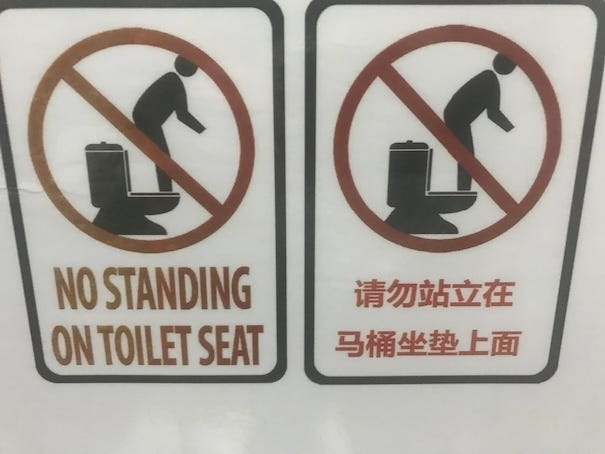
Squat toilets are so common and default in China that it is normal to see signs above seated toilets admonishing users not to squat on top of the seat. No matter the ubiquity of such warnings, it was still not rare to see footprints on toilet seats in even the fanciest of luxury malls. In Shanghai, with its long history of welcoming international visitors, avoiding such toilets was not particularly difficult, but once outside of Shanghai, even in China’s larger developed Tier 1 and 2 cities, sitting toilets often became rare and confined to internationally-oriented businesses.
Still, in Shanghai it was not hard to live your life never once having to squat down to do your business. In fact, I had long made it a point of pride I had never had to resort to such conditions, despite the typical number of impending emergencies induced by substandard cooking oil in Chinese street food. This was a streak that ended ignominiously in a frontier village on China’s border with Tajikistan, where a bout of intense food poisoning led me to train my calf muscles across Xinjiang’s various guesthouses.
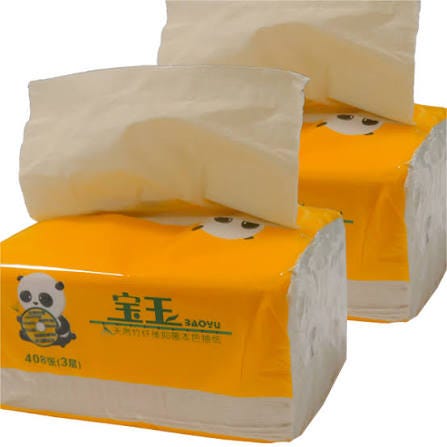
Posture aside, a number of other factors differentiate the public toilet experience in China from other countries. The single most important factor being that, more often than not, the experience is BYOTP, with even restaurants not providing toilet paper, requiring you to always carry (or quickly find a vendor for) a small package of paper that remains mysteriously undifferentiated between toilet paper and tissues. Despite having the tensile strength of a wet mosquito, such paper is rarely flushed, left to be collected in open trash cans adjacent to the pot.
Soap was a rarity, even in hospitals. When the SARS-COV-2 outbreak occurred in Wuhan, likely originating from the Wuhan Institute of Virology, I had numerous arguments with enlightened and highly-educated Westerners who insisted to me that a virology lab would be an unlikely source of an outbreak due to the extensive safety protocols of such labs. Their attitudes changed somewhat when I explained that I have never, not once ever seen soap in a Chinese hospital bathroom.
Ironically, the most common term used for restroom in Chinese is xi shou jian (洗手間) literally “hand-washing place,” yet I rarely saw anyone xi their shou. In fact, I used to refer to the bathroom in my office in Hangzhou as the xichouyan (吸抽菸) because it was far more often used for smoking cigarettes than washing hands.
Privacy is so central to the Western toilet that it is sometimes called the “privy.” In China, privacy is more of an abstract concept. I remember being warned on my first visit to China to always use the toilet before visiting tourist attractions, as the stalls there, if there were stalls at all, would only reach at most a foot or two above the ground. Enough to make you miss the odd two-inch gaps in seemingly every American stall door.
Such “dividers” were by no means limited to rural areas. One Spring day in Beijing I was riding the subway when I suddenly realized I would need to very quickly locate a lavatory. I exited the train and proceeded immediately into the metro’s WC, where I was confronted with a sight very similar to the below image:
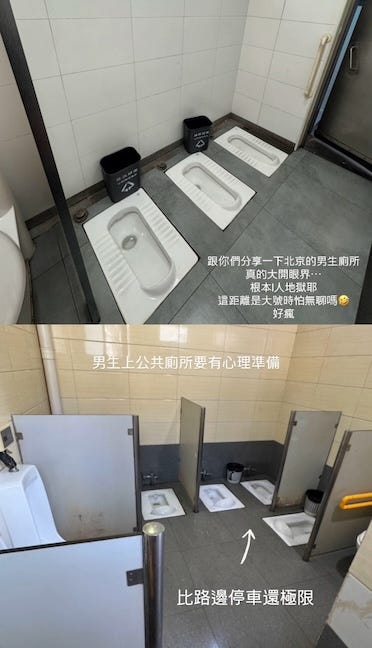
Find this to be unacceptable, and not carrying any toilet paper, I had to exit the subway and dart through the hutongs looking for both a paper vendor and a less-communal latrine. Both missions were successful, but the fear of god was in me that afternoon.
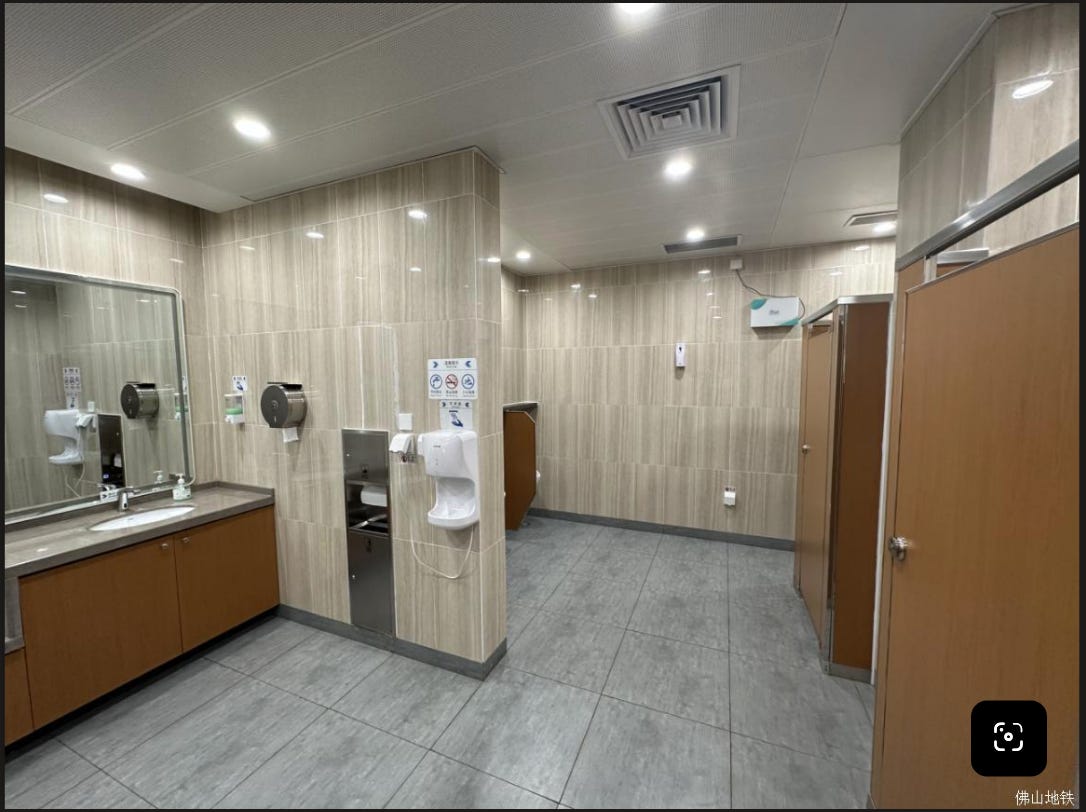
Beijing’s subway, the first in China, opened in 1971, and its bathrooms had presumably not been updated since. By contrast, a few months earlier a new subway station had opened near my home in Hangzhou, and hitting the head one day on the way home, I was pleasantly surprised to find the station bathroom not only sparkling clean with full-sized stalls, but the sink even had an ample supply of soap. This was the new China, new subway lines opening across cities of all sizes, with gleaming new stations built almost overnight. It was also the result of Xi Jinping’s “great toilet revolution.”
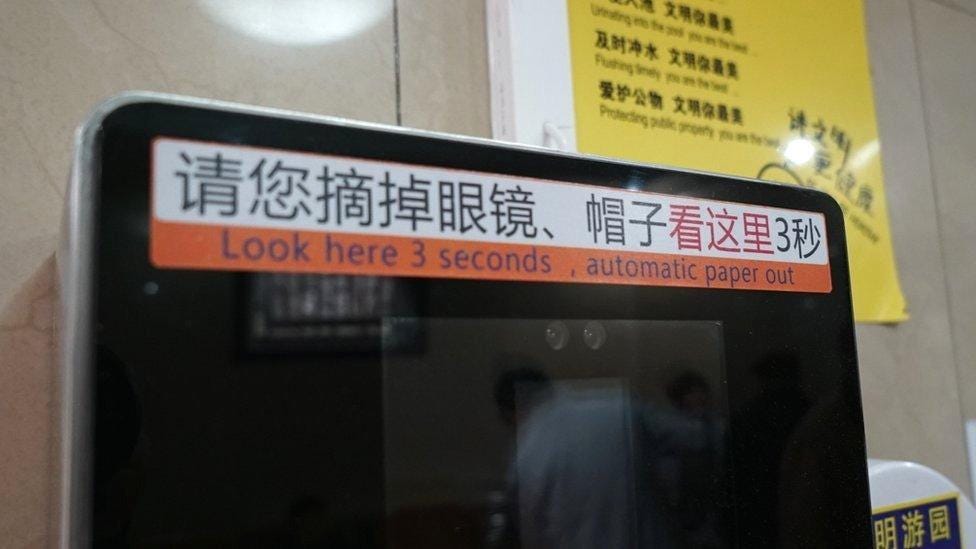
New China brought clean new toilets, but it also brought the full might of the techno-fascist hyper-capitalist surveillance state into the stall with you. In 2017, Chinese public washrooms captured international headlines as a new innovation started appearing: facial-recognition enabled toilet paper dispensers. Although most toilets still did not provide toilet paper, some did, as a single communal dispenser outside near the sinks, requiring some anticipatory calculations prior to doing your business. Finding that they were replacing the roll too often, authorities began to impose a high-tech response to a low-tech problem. After scanning your face, the dispenser would issue a fixed number of squares, and would refuse to dispense additional toilet paper to you for another nine minutes. Facial-recognition has become ubiquitous in China over the past decade, used to persecute minorities and dissidents, as a method of control that has now become super-charged with AI.
The Chinese toilet stall became a microcosm of macro societal changes. Perhaps nothing is more illustrative of China’s transition to hypercapitalist consumerism dependent on smartphone “super apps,” than the latest news that toilet paper dispensers are now requiring users to scan a WeChat miniapp and watch an ad before dispensing sheets.
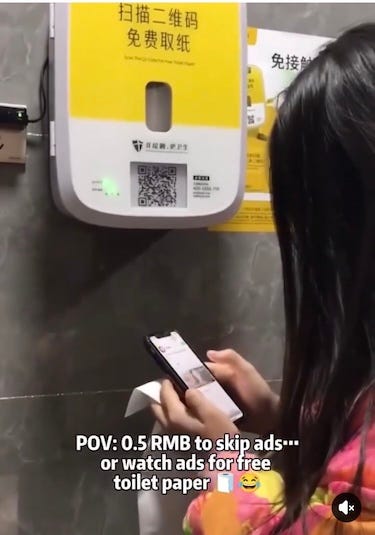
These seismic changes, and the trade-offs that come with them, play out in the toilet stall as they do in the rest of society. The stalls now have doors and toilet paper is available, but they come at the cost of submitting to facial recognition and unskippable ads in the loo.
New China brought clean new toilets, but it also brought the full might of the techno-fascist hyper-capitalist surveillance state into the stall with you.
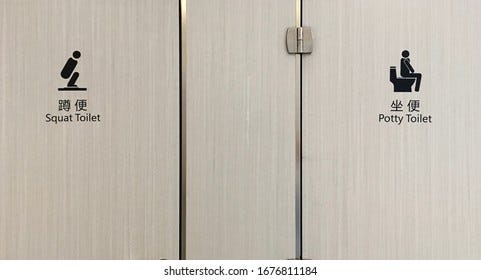
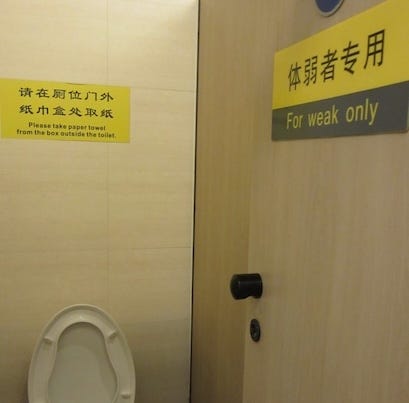
Speaking of stall doors, when stall doors first started appearing in China there tended to be a Russian roulette-esque feeling to punching open the doors and seeing which ones where squatters and which were sitters. As a result, it is common to see signs outside the door making it clear what the situation is inside, with the signage often employing a great deal of creativity- or perhaps even shaming:
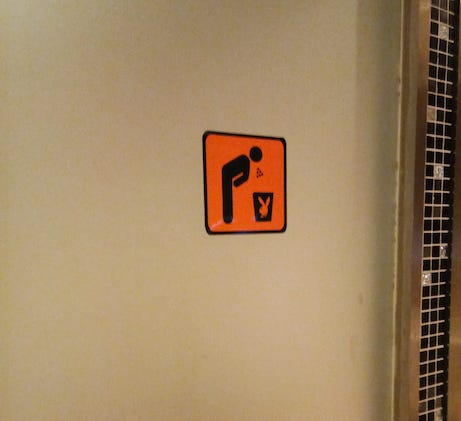
In the KTV halls that dominate Chinese social, business, and drinking culture, one even finds a third kind of toilet: the vomitorium. So normalized is drinking literally ad nauseum in Chinese business culture that an entire toilet stall will be dedicated just to this ritual:
China has changed a great deal over the past decade. The once common sight of an auntie holding her child over a trash can (or street corner) to openly relieve themselves through their crotchless-onsies is now fortunately rare. Public restrooms are now viewed less as a horrifying challenge and more as a convenience. Toilet paper is free… but at what cost?
Crossing the Strait
In 2017, while living in China, I made my first visit to Taiwan, arriving in Taipei’s downtown Songshan airport on an EVA airlines Hello Kitty jet. As I would discover, Taiwan and China are completely different countries, divided by a number of political, historical, and cultural issues, right down to the toilets themselves.
On my first night in Taipei I returned to my hostel after an evening of libations with an urgent need to answer the call of nature. After remixing some of Taipei’s finest Japanese-new wave herbal cocktails, I looked for the flush and discovered a complex remote-control panel covered in traditional Chinese characters, a script I could not yet read. Scrutinizing the options, I saw a button with the water radical and presumed it to be the flush.