

Last month I traveled to Guam for high-level discussions with Guam officials on the Taiwan-Guam relationship and strategic context. Guam and Taiwan have a great deal in common historically, and today they hold outsize strategic importance as the centers of the Second and First Island Chains.
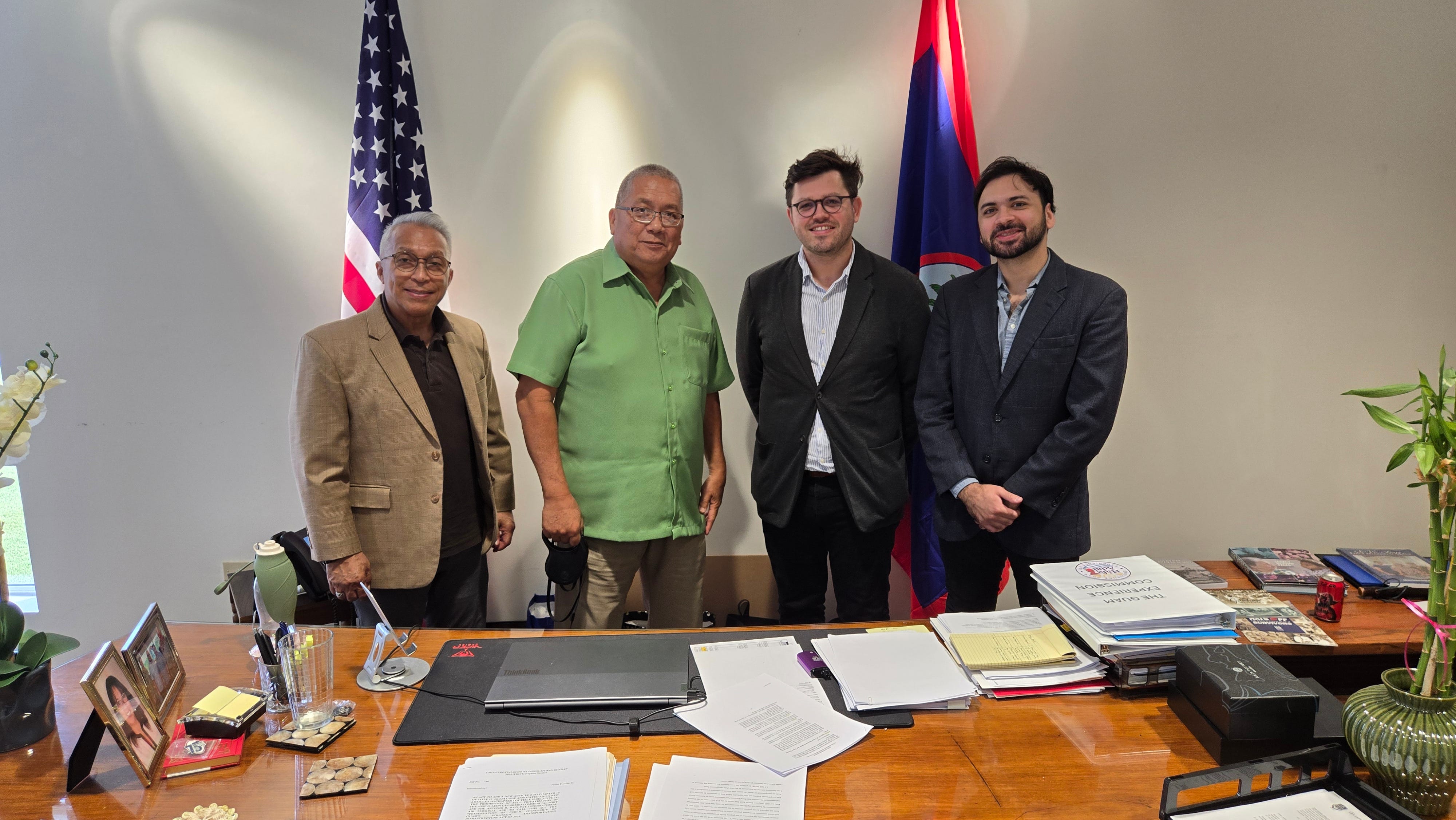
Following my trip, I have just published a column in the The Guam Daily Post, the leading print publication on Guam. I am republishing the full text here for my subscribers, but I encourage you to visit the Post’s website for further insights on Guam:
On the ties that bind Guam and Taiwan
Originally published in the Guam Daily Post, December 19, 2025 (print & online)
“When I see Taiwanese indigenous dancers, I see my CHamoru brothers,” a high-ranking Guam official tells me, as the conversation shifts from intermediate range missiles and air raid preparations to the magnificent people who live at the very center of the first and second island chains.
The distance from Taiwan to Guam was once as short as it was vast. Millenia ago, the ancestors of the CHamoru set out from Taiwan on outrigger canoes on a vast journey of thousands of miles, reading waves by starlight. Yet the distance between the island peoples was short as could be, one Austronesian nation across the blue continent.
Over the centuries, both islands have been coveted by the same empires: Spanish, Dutch or German, Japanese, each leaving their mark - for better or worse - and contributing to a diverse cosmopolitan population. Both ultimately ended up spending the 20th century fighting for democracy under new colonial arrangements: Taiwan under the Republic of China rump regime, and Guam as an unincorporated territory of the United States. While longstanding issues of identity and sovereignty remain unresolved in both societies, Pax Americana has allowed for the flourishing of liberty, free expression, cultural revival, and freedom from domination by authoritarian powers.
Today, these values and progress are threatened, as China’s growing strength and power-projection capabilities lay clear its ambitions to dominate the Indo-Pacific and expel the United States from the region. Any claims that China intends to rise peacefully or merely secure its economic development are belied by its designating of an intermediate range missile as the “Guam killer,” and its building of full-scale replicas of Taiwan’s presidential office building at military training sites.
As China reaches across the globe to threaten Pacific fishing stocks, conduct dangerous live-fire exercises off the coast of Australia, open illegal police stations in the continental United States and Europe, and build illegal island bases in the West Philippine Sea, the importance of containing China’s expansionism has become a clear priority for the United States and her allies, generating renewed interest in Guam and Taiwan as the “tip of the spear” in the Indo-Pacific.
Yet these island homes are far more than simply logistical waystations or would be battlefields protecting freedom for the world beyond. Yes, they are, and the free world owes these islanders an enormous debt for bearing their geographical burden. They are also enormously special places with rich culture and global importance that have much to offer the world, but are often held back by a world that views them merely as militarized outposts and geopolitical pawns.
Over the centuries, both islands have been coveted by the same empires: Spanish, Dutch or German, Japanese, each leaving their mark - for better or worse - and contributing to a diverse cosmopolitan population.
Guam and Taiwan have opportunity to demonstrate how US and Taiwanese cooperation can lead the way in defending prosperity in a new era. Already, Taiwanese investment in AI-driven aquaponics on Guam are leveraging Taiwan’s technological and agricultural strengths to bring fresh and affordable food to the island. Future technology transfers of Taiwanese advanced fish-farming techniques have the potential to restore Guam’s historical fisheries sector while reducing dependencies on frozen imports.
A great deal of these successes are a result of successful subnational diplomacy by the Taiwanese, who made the wise decision in 2020 to reopen their representative office - a consulate in all but name, recognizing that building ties with the people of Guam was an essential strategic step to strengthening relationships with both the United States and the Pacific region. Indigenous cultural exchanges have restored ancient connections between the two islands, and Guam’s inaugural participation this past week in the World Indigenous Traditional Games in Kaohsiung, Taiwan marks an important milestone.
Guam and Taiwan are united not just by their shared past, but by their shared future. Growing threats to energy security, undersea cable connectivity, and increasingly powerful typhoons all make building resilient societies a shared concern. Guam should join Taiwan’s Global Cooperation and Training Framework (GCTF) as a subnational member, which addresses these issues and more through shared cooperation and collaboration across regions.
Guam could host the next iteration of the GCTF’s International Austronesian Languages Revitalization Forum, setting the stage for future Guam-based educational collaboration and exchanges. While existing educational exchanges largely focus on indigenous issues and agriculture, future academic exchanges should include security studies as an area of critical importance in the Pacific region.
Despite the presence of geostrategic security questions in everyday life on Guam, it remains underdeveloped in security studies, particularly when compared to Hawai’i. Guam should leverage its reputation as a well-established training center for the region that is able to attract elites and talent from Pacific islands states that are foreign policy priorities for Taiwan to invite Taiwanese investment in Guam’s education system. Just as Taiwan’s Ministry of Education supports numerous Taiwan Studies programs around the world, it should be enticed to support an Indo-Pacific security studies program at the University of Guam, which could issue joint degrees or certificates with a leading Taiwanese university.
That the future of the free world depends on strong ties between Guam and Taiwan is not an overstatement. At a time when China is sowing distrust of the United States within Taiwan, the people of Guam have the opportunity to show a genuine brotherly connection with their Taiwanese cousins. This trust is foundational to a mutually beneficial relationship as both societies navigate the turbulent future, seeing each other not just as comrades in arms, but as partners in economic, educational, and cultural development for all.