

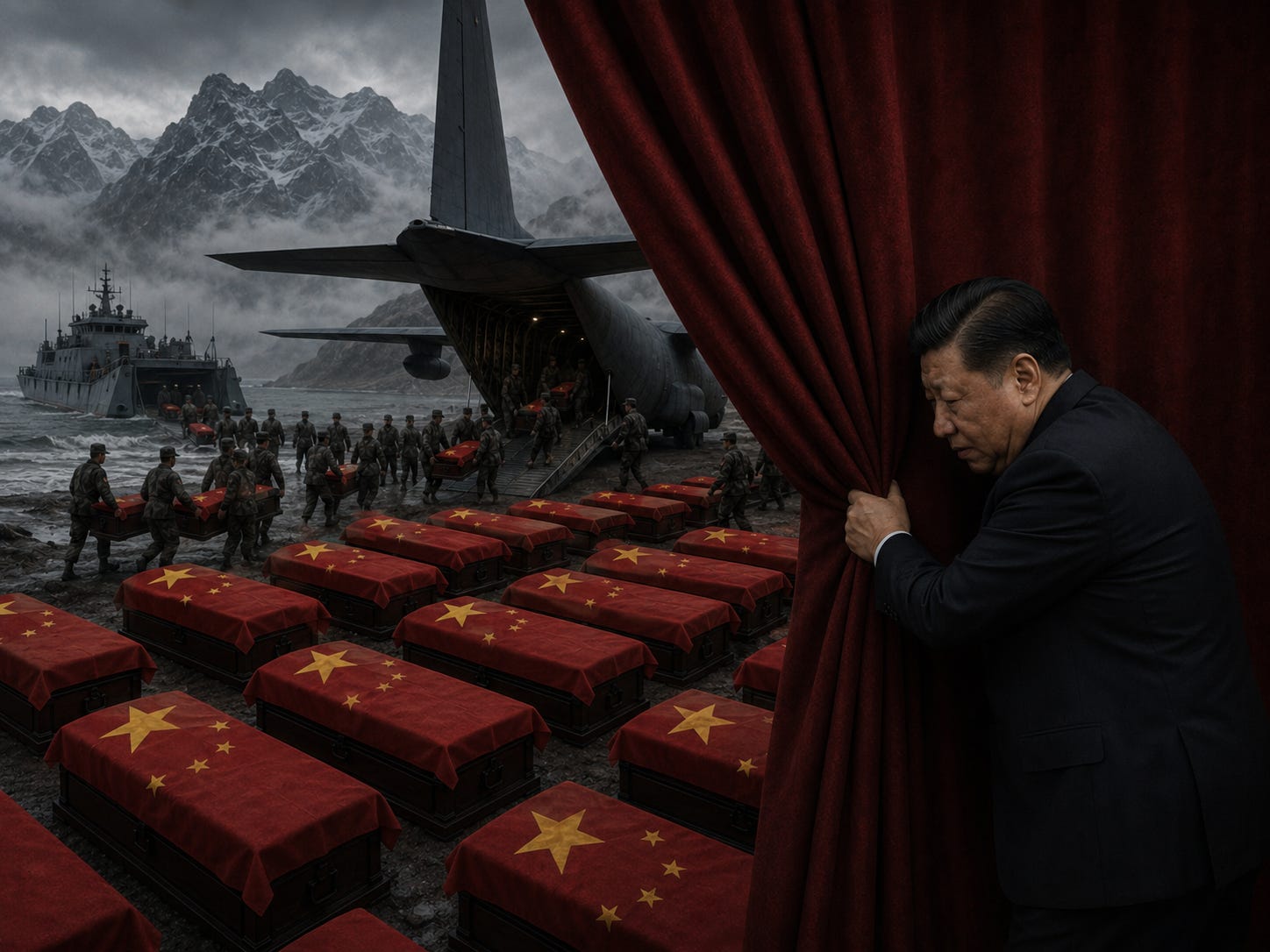
This week in Taiwan, as the country undergoes its largest annual military exercises, involving air, sea, and land drills and calling up thousands of reservists, the international media are asking again and again: are the Taiwanese ready for war? Polls consistently suggest a clear majority of Taiwanese are willing to fight, yet the midnight debates in Taipei (and in Washington) endlessly interrogate the size of the gap between what many young Taiwanese men will say on the phone compared with how many will actually show up on the brink of war to defend their shores and likely die for their nation.
It’s an important question. I think the Taiwanese will be more likely than not to defend their homeland. But perhaps more intriguing is whether China is ready to send tens of thousands of single sons to their deaths for so-called national unity.
I’m not entirely convinced.
Earlier this week, China officially confirmed that two Coast Guard personnel were “martyred” in a high-profile incident last year when a Chinese Coast Guard cutter crashed into a Chinese Navy destroyer while harassing a Philippine Coast Guard ship in the disputed waters surrounding the Scarborough Shoal in the South China Sea/West Philippine Sea.
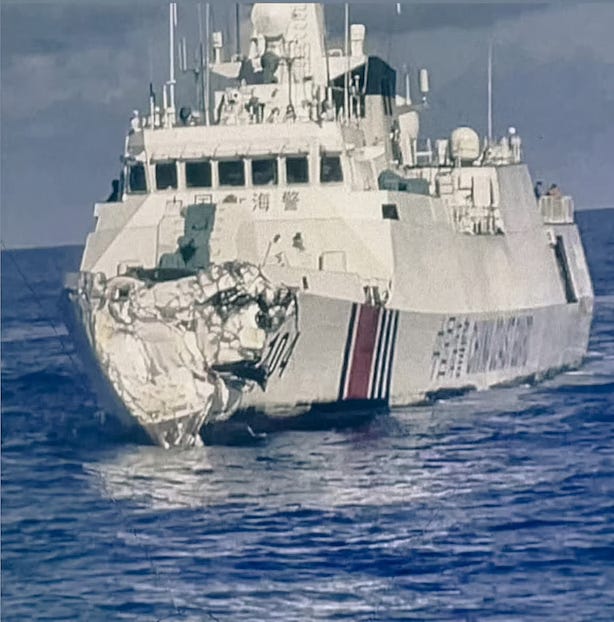
The Scarborough Shoal is illegally occupied by China yet claimed by the Philippines, which is far closer to the atoll than China is. An international tribunal ruled in 2016 that China’s claims of sovereignty were without effect, and affirmed the rights of both countries’ fishermen to access traditional waters. China’s response has been to chase away Filipino fishermen with violence and illegally restrict their access, prompting the Philippines Coast Guard to patrol in protection of its fishermen.
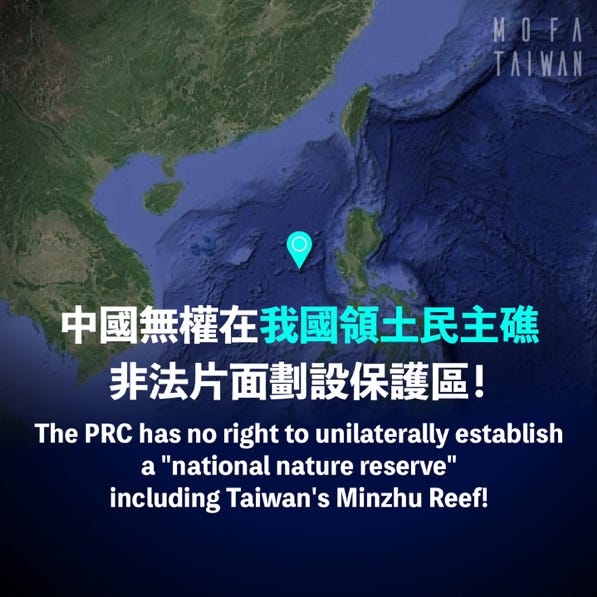
Taiwan’s response has mysteriously been not to support an allied democracy, its third most important military ally, the Philippines, against China’s expansion, but to instead side with China, with the DPP government incongruously resurrecting ROC claims to the entire South China Sea to claim incorrectly that the Scarborough Shoal belongs to Taiwan. Taiwan’s Foreign Ministry reiterated the absurd claim this week, without a clear explanation as to why it feels a strong need to speak out on this issue while also happy to ignore the ROC’s claim to Mongolia or the Senkaku Islands.
The Philippines had previously asserted in the days following the August 2025 incident that two Chinese Coast Guardsmen had been killed in the collision. China refused to confirm any casualties, and aggressively censored any discussion on the Chinese internet speculating that Chinese personnel may have died in the incident.
It took nearly exactly a full year for Chinese authorities to publicly acknowledge the deaths of the two young men, and even as their official citations with the Ministry of Veterans’ Affairs list them as “martyrs” who died “heroically,” there remains no official statement or official commemoration of their deaths. Chatter is rising on the Chinese internet, but the government has yet to explain to its people why these young men died a thousand kilometers from their homeland, or even publicly commemorate their sacrifice for the nation.
The delay comes as no surprise. China has long struggled to deal with the fatal fallout of its modern border skirmishes with its neighbors. The episode almost exactly parallels a much more violent incident in 2020 when Indian and Chinese forces skirmished for months along the two countries’ undemarcated Himalayan frontier. Restrained by the threat of nuclear escalation, the two armies have long resorted to hand-to-hand combat in the hundreds of standoffs and skirmishes that have broken out in the years following the 1962 Indo-Chinese war.