

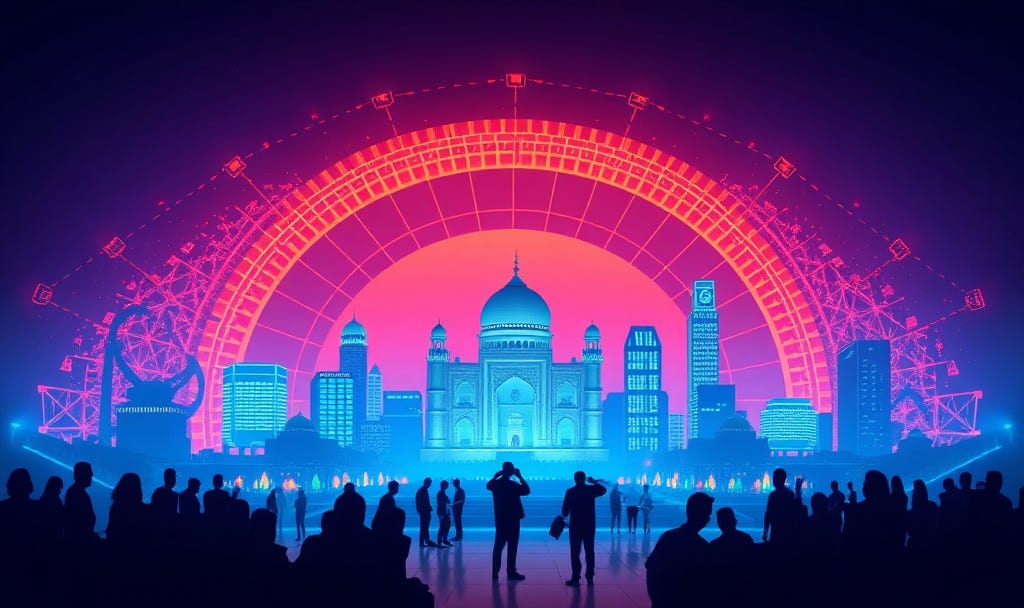
It is a cliché to say there are two Indias, nonetheless I find myself struggling for a more cohesive heuristic to capture the dualities I experienced on a recent visit to attend the AI Impact Summit in New Delhi. The AI Impact Summit was the fourth of series of major international summits on AI, held in Bletchley Park, Seoul, and Paris, drawing delegations from hundreds of countries, including dozens of heads of state and titans of the tech industry, this would be the first for the Global South.
On the one hand, there is a vision of a new India as an emerging global power, not just driven by, but driving rapid innovation in technology and AI. This India is characterized by the Aadhaar biometric ID system, which has efficiently distributed welfare to India’s large unbanked population; or the Universal Payments Interface which has now surpassed Visa as the world’s largest digital payments platform, all without fees. This is an India that seeks to be a model for the developing world, and to be seen as one of the world’s leading great powers. Let’s call this India “Bharat,” because that is what the government seems to want to call it.
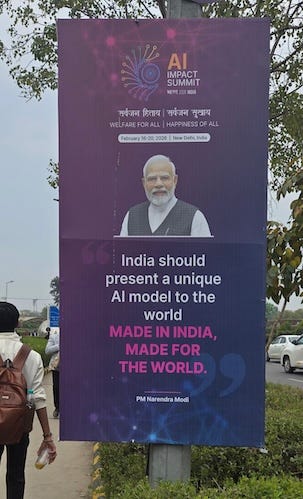
On the other hand, there is the India that emerged from the shackles of British colonial oppression. One of the world’s ancient and great civilizations reshaped over centuries bureaucratically and physically by the straightjacket of the English administrative state, this is the India that has the world’s largest population in extreme poverty and a bureaucracy more Byzantine than Byzantium.
It is also the India that has spawned the world’s most effective non-violent freedom fighters, democratized live-saving medicines for the entire world, developed nuclear weapons, and become the world’s largest and most successful ongoing experiment in multilingual pluralistic democracy. This is the India typified by the architecture of Edwin Lutyens that characterizes New Delhi’s walled bungalows and rarefied social clubs, and the choked streets of capitalist India that run through them. Let’s call this one “India.”
India sent off a generation of highly-educated, hardworking, English-speaking migrants to the West, where they went on to lead the world’s most important tech firms, become the highest-earning ethnic group in the United States (this distinction alternates annually with Taiwanese Americans), and raise children who would attain high positions of elected political power.
Bharat now hopes to entice them back.
I spent the week traversing between India and Bharat, seeking to understand where India was going, how AI was transforming the country, and how the world was perceiving India’s ascendance on the world stage. For me, also top of mind were the important questions of how India was thinking about China’s strategic challenge, what opportunities lay to strengthen India’s relations with Taiwan, and how it might respond to a Taiwan contingency.
Well-organized Chaos
The chaos of the first days of the AI Summit has been well-documented in other outlets, including security protocols so strict that most electronic devices, including laptops, wireless earbuds, phone chargers, and even car keys were officially banned from the tech summit. Many approved attendees were turned away after waiting for many hours. Having been well-warned of this by local colleagues, I skipped the first two days.
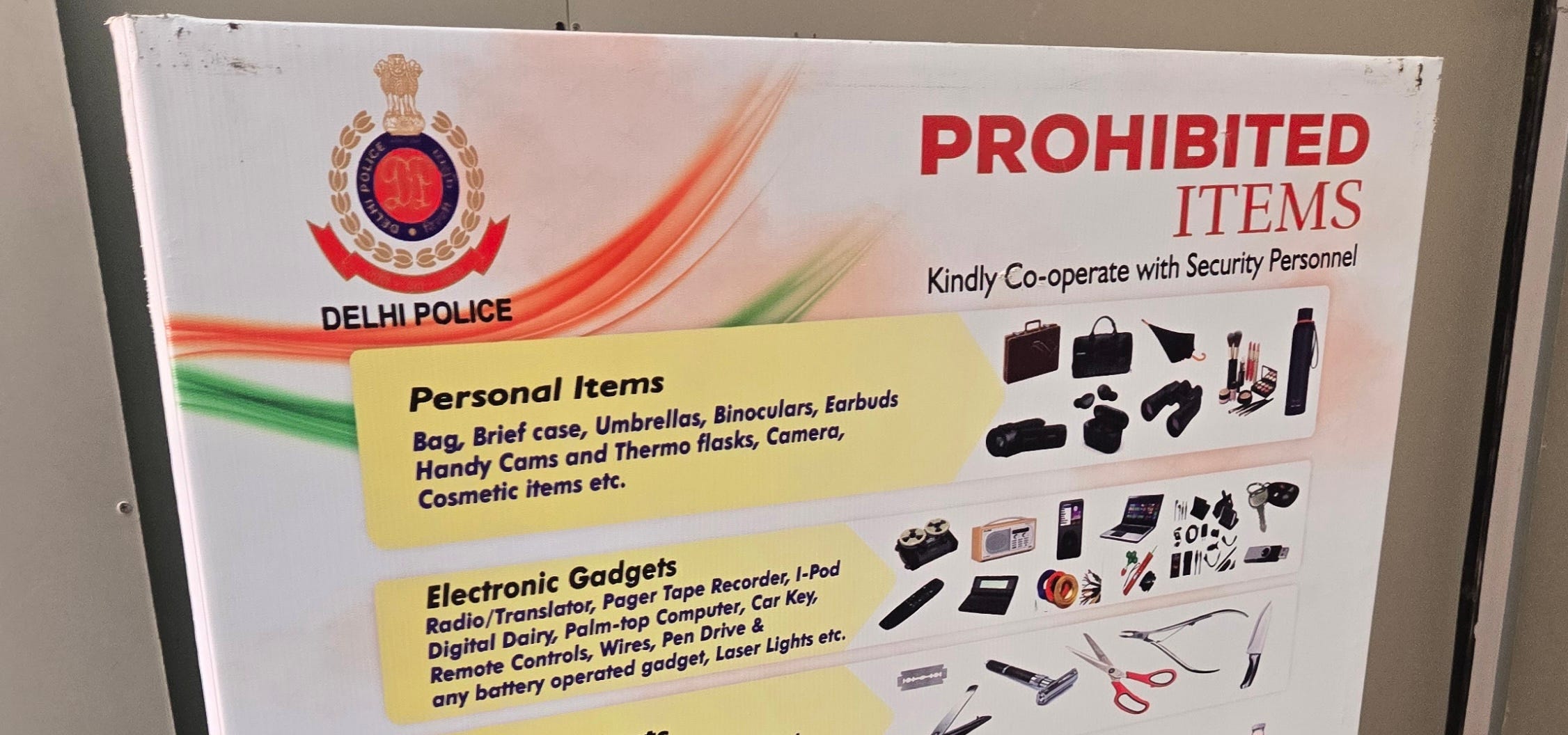
I arrived at the Bharat Mandapam convention center on the third day, toting wireless earbuds, phone charger, and a power bank for good measure. Hoping for the best, I proceeded through the queue, and after passing through and setting off the metal detector, was directed straight in with a light pat on the shoulder and no examination of my metal objects. They even forgot to scan my QR code! Was I in Bharat or India?
The scale of the expo itself was truly impressive. Bharat Mandapam is one of the largest convention centers I have ever been to, and every hall was packed full of booths and exhibitions showcasing developments in AI of every shape. Every Indian state had pavilions showcasing real-life use cases for using AI to improve the delivery of services, in-line with the summit’s theme of “Welfare for all, happiness of all.”
AI is rapidly transforming the state’s relationship with its citizens, and in India, this is viewed primarily as for the better. In one session, a panelist from southern India recounted the implementation of an AI system to assess post-typhoon crop damage for calculating relief payments to farmers. Satellite images are analyzed by AI that immediately assesses the relief benefit owed, which is instantly transferred directly to the farmer via Aadhaar.
Under the previous system, damages were laboriously assessed by sending government inspectors to each individual plot around the state, where they rated the damage based on their personal assessment on a numbered scale. This data was all then compiled centrally and relief payments assessed and sent out through traditional methods, a process that could take weeks or even months.
But the speed is not even the most impressive part. According to the panelist, under the previous system, approximately 17 crores (170 million INR or ~1.8 million USD) in relief payments were issued each season. Under the new AI satellite system, this was reduced to only 4 crores (40 million INR or ~434,000 USD), all without a single complaint from the farmers.
Without a single complaint.
Even if the AI relief system is functioning with 100% accuracy, if you reduce payments to a segment of the population by more than 75%, people are going to complain that there is a lot less money in their pockets under this new system.
The most plausible explanation to me is that the balance of 13 crores (~1.4 million USD) was simply a measurement of corruption in the system. With the traditional system so reliant on the individual observations of hundreds of inspectors, it is easy to imagine vast corruption, both centralized and decentralized, where these numbers are being inflated with corrupt officials pocketing the balance. That difference being due to corruption would explain the lack of complaints: farmers are still getting the same amount of relief, and corrupt officials are unlikely to make a formal complaint about losing their source of graft.
Corruption is a serious problem in India, as in most other countries, with estimates of as much as $50 billion USD siphoned away annually. If AI can truly put a dent in this figure, it could be truly transformative for innovation, productivity, and accountability in the Indian economy.
Indian AI-enabled Defense Tech
In the exposition halls I visited the Ministry of Defence pavilion, where various new AI-enabled hardware and software products were being demonstrated. There, I came across the following product from one of India’s defense research labs: an AI-enabled helmet with a real-time Mandarin to Hindi translator.
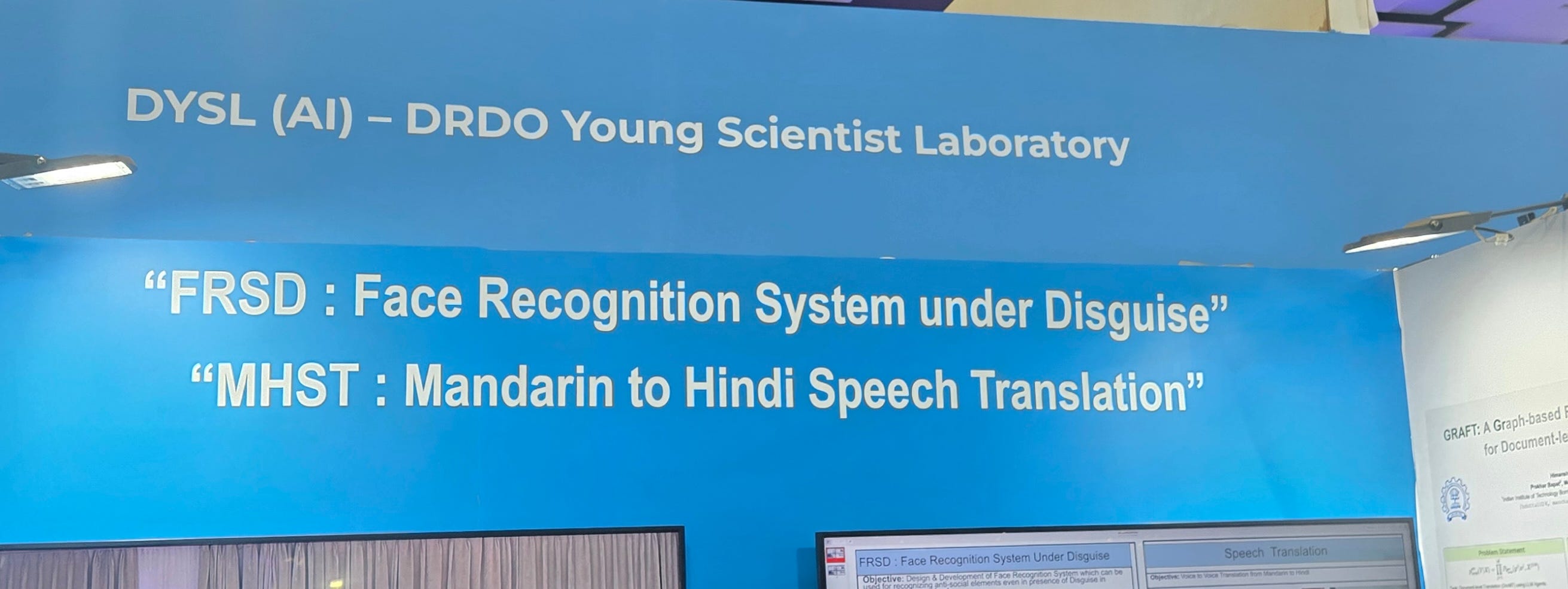
The development team touted the successes of the device in initial tests on the borders with both China and Nepal (there is a Nepali version). The dictionary-sized device is meant for use by troops posted in poorly marked border regions, where Indian and Chinese patrols often cross paths, sometimes quite violently. The device, which works offline, is meant to eliminate communication issues between the two sides, as well as to allow the Indian side to understand communications between and among Chinese troops within earshot.

In such situations where nuances in communication between frontline troops can lead to outbreaks of violence or effective changes to the status quo, clear communication and understanding of the other side is essential. Mandarin is of course an infernally complex and nuanced language, and specific phrases in a political or military context often carry great weight.
Naturally I wanted to understand how accurate the system was, and if it was developed with not just linguistic accuracy, but specific knowledge of Mandarin phrases used in political and military contexts. I spoke with the development team, who assured me it was more than 80% accurate.
That would be quite impressive, roughly matching Google Translate’s offline accuracy for Mandarin, a tool built on one of the world’s most powerful LLMs and refined by hundreds of native Mandarin speakers.

When I asked the team about their use of Mandarin speakers in product development, they informed me that they had used Mandarin-speaking contractors, but were limited given that they could only use Indians who spoke Mandarin as a second language, as hiring native speakers from China was naturally prohibited.
Indians are probably the most multilingual people on the planet, but unfortunately Mandarin is not commonly taught in India, and very few people speak it to a high level. In conversations in policy circles in New Delhi, I am frequently given the number that no more than a few dozen people in the entire country are functionally fluent in Mandarin. I would be skeptical that the Indian contractors this lab hired not only had fluent Mandarin, but a nuanced knowledge of the specific military and technical terms used by the PLA.
After sharing with the team my background in Taiwanese defense think tanks, I raised the prospect of collaboration with Taiwanese, who in addition to being native speakers of Mandarin, have firsthand experience of daily military encounters with the PLA. Taiwan and India both face regular grayzone encounters with the PLA (although Taiwan’s fronts are maritime and aerial, while India’s is largely on land), and have similar challenges defending their territory while working to deescalate encounters. Surely among the many opportunities for Taiwan and India to share experiences and collaborate, Mandarin expertise is an easy entry point?
But you see, one of the exhibitors explained to me, we can’t work with anyone in China, it’s a security risk. I told him that’s precisely why Taiwan is a great and secure partner to work with. His response: But isn’t Taiwan part of China too?
I don’t blame this technical development team for not knowing the very basic fact that Taiwan is independent of China. It’s a small, faraway country, and one that has not done enough to explain itself to the world, particularly in countries such as India. Often the importance of publicizing Taiwan’s independence is downplayed in favor of “more practical” opportunities for collaboration, but we see here that this failure of public diplomacy indeed impedes very critical opportunities for collaboration and stronger ties, including in the security domain.
Often the importance of publicizing Taiwan’s independence is downplayed in favor of “more practical” opportunities for collaboration, but we see here that this failure of public diplomacy indeed impedes very critical opportunities for collaboration and stronger ties, including in the security domain.
Moseying back to the main hall from the exposition was a transition from Bharat to India. Halfway to the main building, gates had been suddenly stood up, with just a small two-meter-wide opening through which guards were only allowing traffic in one direction, leaving no way to actually return to the main hall. Arriving at the chaotic throngs trying to surge in each way, I found a single guard manning the opening, shouting directions only in Hindi, a language few international attendees would understand, to those trying to return to the main hall. Eventually, a path was found, a single-file passage between two rows of metal barriers over a muddy field, after which there was a lengthy walk to approach the hall from the other direction. Returning indoors, I attended a session where a panelist gleefully exclaimed how AI had broken language barriers to such a degree that government information could be communicated seamlessly in individual village dialects spoken by only a few hundred or few thousand native speakers.
For all these organizational shortcomings, it is important to note the importance of the event to Indians themselves, the majority of attendees and beneficiaries of the summit. Exorbitant costs, distances, and visas often preclude Indians from attending major international summits in Europe and North America. Despite all the shortcomings, bringing a major international summit to India is a significant success. That being said, this makes it all the more important that India organizes summits well enough to ensure it can continue to draw major international attendees and speakers to return.
AI for All?
After the summit I attended a dinner reception organized by the Observer Research Foundation, the Gates Foundation, Carnegie India, and the EkStep Foundation, featuring former UK Prime Minister Rishi Sunak and several other notables including the head of the Gates Foundation in India (Bill himself made a hasty exit from the summit due to prior associations with a certain Caribbean island…), and former Trump AI advisor-turned Trump critic, Dean W. Ball, whose Summit reflection on his Substack, Hyperdimensional, is well worth reading.
The dinner was themed AI for All: Reimagining Global Cooperation and followed a daylong South-South workshop bringing together participants from the Global South to ensure they would not be left behind in the AI discussion, in-line with India’s positioning on hosting the summit. In scene setter remarks, Sunak articulated an inescapable through line of the summit, readily apparent to anyone regularly passing between emerging and developed economies: in the developed and industrialized West, there is incredible rank pessimism and outright fear of AI, from workers to intellectuals, fear of looming job losses, fear of an erosion of students’ critical reasoning skills, fear of the destruction of intellectual property protections, fear of global annihilation by artificial general intelligence.
In the developing world, or emerging economies, however, there is incredible optimism for AI’s revolutionary abilities to transform citizens’ lives. Part of this is the nature of the developmental state, in developing countries, there tends to be more optimism, or at least a stronger view of the responsibility of the state to transform citizens’ lives, a concept largely rejected in the capitalist West. Part of this is also the democratizing nature of AI, which has already led to the revolutionary changes in access to citizen services outlined previously.
But how democratizing is AI? Global compute remains dominated by the United States and China, the only AI powers capable of producing frontier models, and cutting edge chips remain controlled by a US-led hardware alliance including the Netherlands, Japan, and Taiwan. The South-South dialogue was meant to ensure Global South countries have input into the future of AI, but without hyperscalers, frontier models of their own, or access to next-generation chips, it’s hard to see how any emerging economies will shape AI’s future.
Canadian Prime Minister Mark Carney said “if you’re not at the table, you’re on the menu” at Davos this year, referring to geopolitical hard power. The same applies to AI: if you’re not building frontier models, you’re may just be the dataset.
Welfare for All
Frontier AI models were the last thing on my mind as I sat for nearly two hours unmoving in a congested lane returning to New Delhi from South Delhi’s Chhatarpur district; mild-weathered February is Delhi’s wedding season and Chhatarpur’s idyllic farmhouses offer green expanses only five miles from central Delhi. Yet on the road I witnessed a complete collapse of the traffic system, moving two kilometers in two hours on a major thoroughfare.
As we inched towards a major intersection, the source of the stoppage became clear, a single traffic light would turn green for exactly fifteen seconds, before immediately turning red again despite no cars having budged from the stoplight. With cars pouring in illegal directions from every which lane, there was simply not enough time in 15 seconds for any car to react and inch forward before traffic resumed perpendicularly.
Setting aside enforcement issues of traffic laws in India, from a technical perspective, this is a trivial problem to solve algorithmically. Running a traffic light on a timer may work in a rural area or a time predating the integrated circuit, but integrating even a single sensor to optimize traffic flow is trivial and can be solved by a first year computer science student, even without the most basic of AI-directed algorithmic assistance.
As we sat unmoving for hours, pollution from idling diesel cars fouling the lungs and watering the eyes, commuters lost precious hours with their families, goods being transported interstate faced market delays or spoilage, long-distance truckers grew fatigued and weary, and cattle and children alike wandered dangerously among idling traffic.
These were intolerable conditions to any citizenry, an abject failure of democratic governance to respond to basic needs of working and monied classes alike. In India, traffic is democratizing.
Well, almost.
I could not help but think back to my attempted departure from New Delhi’s swanky Oberoi Hotel following the AI for All dinner earlier in the week. Following the conclusion of the dinner, I attempted to order an Uber, only for the driver to inform me he was stopped at a roadblock two miles away from the hotel. With no signs of improvement, and a failed attempted escape through the staff entrance, the crowd began to swell in the hotel driveaway as private drivers, taxis, and Ubers were all sealed off from a two-mile radius in the center of New Delhi.
VIP movement sir, please wait. And wait I did, sequestered in a five-star hotel with several heads of state, foreign government ministers and deputies, and a good portion of New Delhi’s diplomatic corps. Apparently none of us were VIP enough to be allowed to leave the hotel.[1]
What hope is there that a simple traffic light will be upgraded when those responsible for it have never stopped for one?
For two hours I waited in the brisk New Delhi evening, unable to leave, with no way of knowing when the VIPs would finally relent and return the streets to the people. Inside the gilded Oberoi, heads of state and tech executives hailed Bharat’s advances and Global South attendees embraced a new non-Western approach to AI. Yet outside I felt I was in Ashgabat.
What hope is there that a simple traffic light will be upgraded when those responsible for it have never stopped for one?
A country whose leaders isolate themselves from the daily realities of their people, particularly those of the middle class, will eventually find themselves in a crisis of legitimacy with the very people they purport to serve. I am no expert in Indian politics, but this is clearly what befell the Congress Party after many decades, and I have no doubt the BJP will eventually fall into the same trap.
Looking East
On my last day in New Delhi I attended a talk by Professor Yan Xuetong, of Tsinghua University and one of China’s leading IR scholars. Normally far more nuanced than most Chinese academics, Dr. Yan can be insightful on the mood in Beijing, even as he shirks the thornier questions around Beijing’s regional and global challenges.
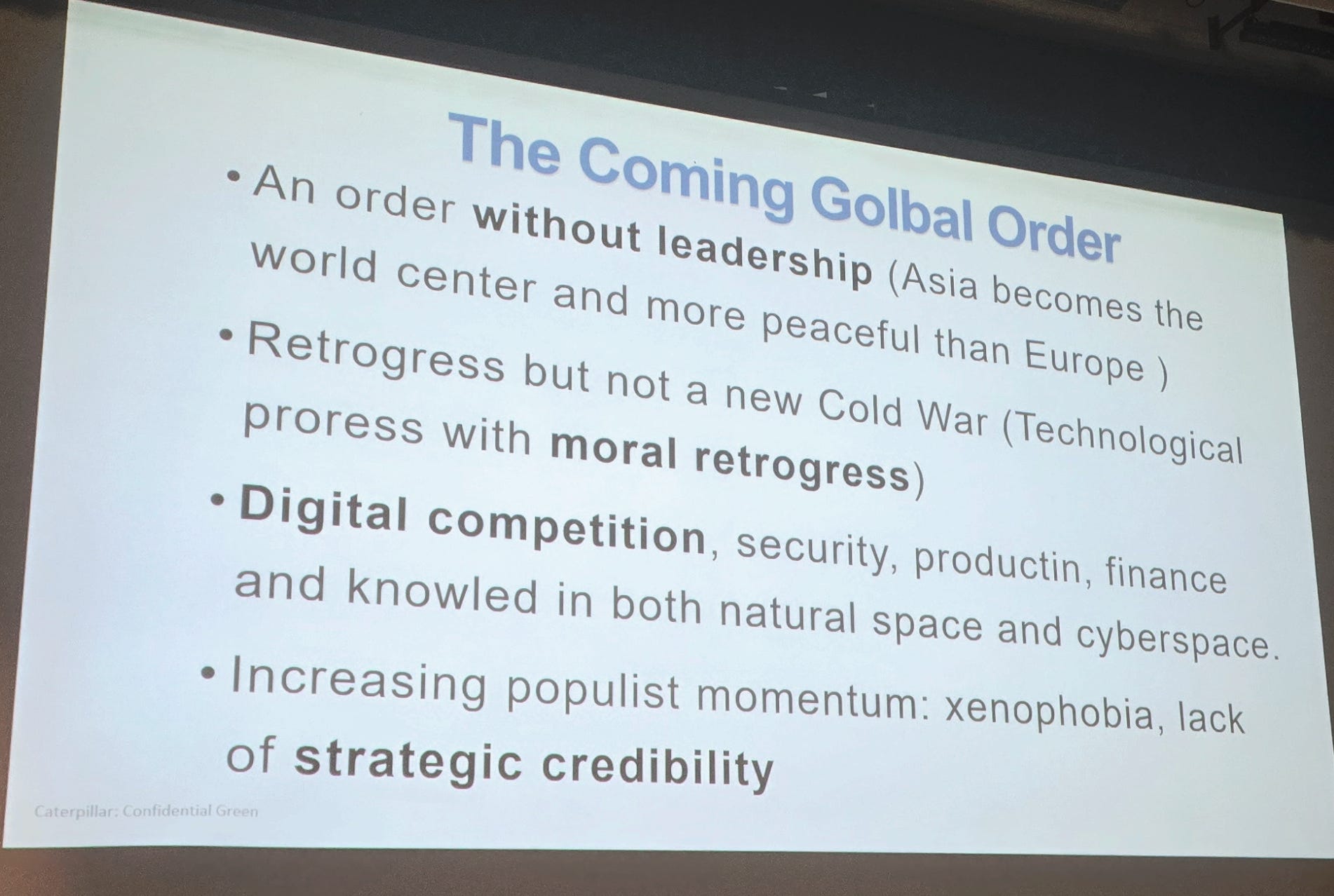
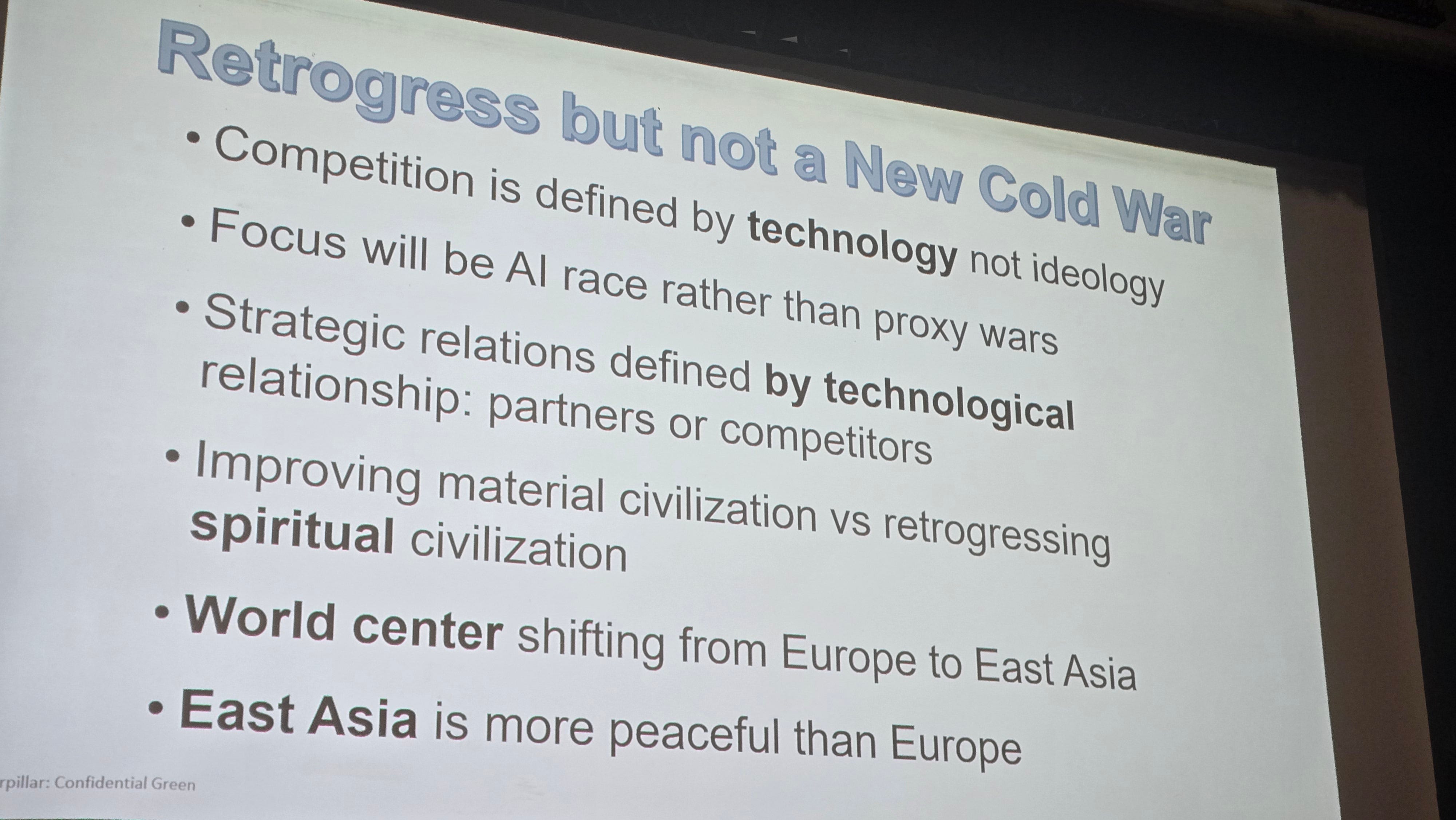
Dr. Yan’s talk “Trump’s Challenge to the Global Order,” drew a large crowd and generated much interest among New Delhi’s strategic thinkers. I thought he made a good-natured effort at attempting to win over Indian thinkers, criticizing Trump’s leadership of the United States while highlighting the importance of moral and spiritual leadership, predicting a recentering of the world away from Europe and towards Asia.
At the end of the day, Dr. Yan failed to win over anyone in that room because Indians know the challenge posed by China is greater than any damage the US could ever do to India. For all focus on US/China confrontation, it remains true that India has been one of the few modern countries to face direct military conflict with China, as well as the one most recently to have engaged in direct combat with China’s most advanced weaponry. Independent India’s sole strategic defeat against an external adversary has been its war with China in 1962, and last year’s conflict with Pakistan (Operation Sindoor) saw Pakistan testing advanced Chinese weaponry against India.
While India is unlikely to ever align its policy with the United States as its East Asian allies do, structural reasons will ensure that India and China will remain adversaries on multiple fronts. This structural competition however, should not be viewed as a constraint, but rather as a freeing of India to engage in an independent foreign policy unconstrained by any great power.
This has led to an India that is able to have security relationships with Russia and the United States, Israel and Iran, Tajikistan and Vietnam, Australia and Japan.
Why then not also Taiwan?
This structural competition however, should not be viewed as a constraint, but rather as a freeing of India to engage in an independent foreign policy unconstrained by any great power.
I have long argued that India can brush up against China’s so-called redlines on Taiwan in a way almost no other nation can. Not only does India have no official “One-China policy,” but it has a delicate strategic balance with China that almost no other nation has. I view India and China as having four main fronts for confrontation:
The disputed and undemarcated India/China border in the Himalayas.
The India/Pakistan conflict, where China supports Pakistan militarily.
Competition for influence in India’s South Asian neighbors (Nepal, Bangladesh, Bhutan, and the Maldives).
Power projection into the Indian Ocean and Strait of Malacca.
Each one of these fronts operates on its own highly calibrated logic, and all but one include the agency of third states that are highly inclined towards de-escalation.
That is to say, Pakistan is not going to stir up border conflict at China’s behest if India engages in security dialogue with Taiwan. Bangladesh is not going to elect pro or anti-Indian leaders based on India’s trade with Taiwan. China is not going to be more or less able to secure shipping lanes in the Strait of Malacca whether or not the Indian Navy transits the Taiwan Strait or conducts joint exercises in the South China Sea.
Why then, are India/Taiwanese relations extremely underdeveloped, not merely in security, where both sides face the same ultimate threat, but in trade, academic, cultural, and people-to-people exchanges? The basic problem stems from a mutual lack of understanding on both sides. Taiwan is a small and far off place that has few Indian tourists or expatriates, making it less prominent in India compared with Middle Eastern or Southeast Asian states.
Taiwan has its own island insularity that leaves it lacking expertise and curiosity on far off states. It knows Japan well, it has extensive ties in Southeast Asia, but India seems a far-off place beyond the mountains, and stereotypes predominantly color Taiwanese views of India.
In conversations with officials in New Delhi, I cannot escape the truth that there is simply an order of magnitude missing to how the two Asian democracies appear to each other. Despite interest in both sides on improving the relationship, the lack of a direct flight is such a basic impediment to even the simplest exchanges. It is often faster to fly to Europe from Taiwan than to India, and both sides currently lack enough talents with suffienct linguistic and historical fluency in both countries to foster a warming of ties, whether academic, business, or even tourism.
The coming arrival of 1,000 migrant workers from India to Taiwan may be just the start that is needed. As conflict roils the Gulf countries, Taiwan may well emerge as a place of great interest to India. The potential areas for cooperation between India and Taiwan are numerous: beyond migrant labor to well-managed tourism, educational exchanges, track 1.5 foreign policy and security dialogues, skilled manufacturing, and of course the AI industry.
This will simply take time to happen. When it happens, it will happen if the same conditions are created as were in the West, the Gulf, and Southeast Asia: there is a need to nurture a generation who are comfortable in both countries and elevated to positions of prominence to make true durable cooperation happen.
[1] I will note the Oberoi manager did offer me an exorbitantly priced house limousine for a one-way trip