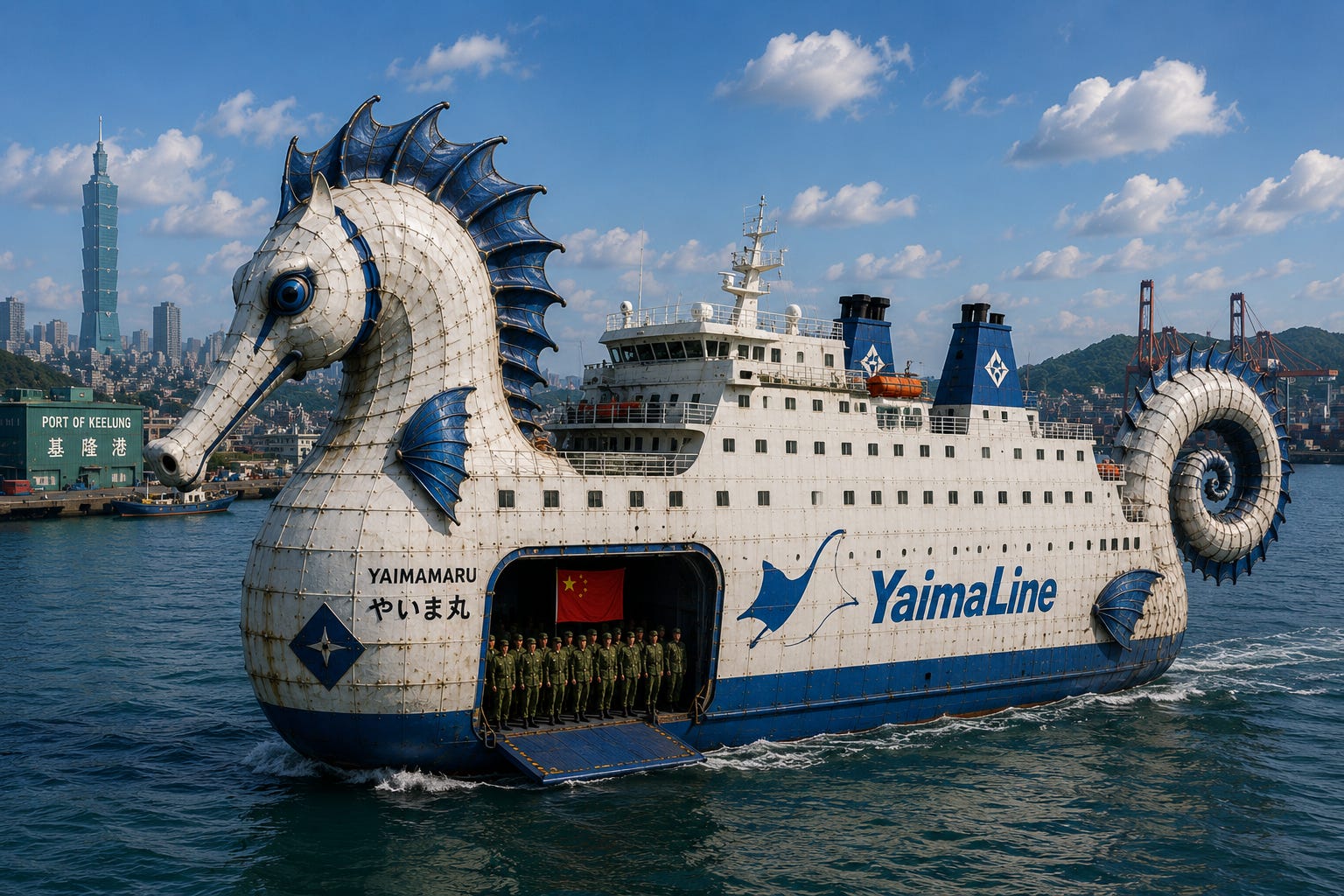
I hope Taiwan will soon return to the motherland. The phrase, barked in the sharp consonants of Northeastern Mandarin Chinese, was not new to me. But hearing it from a uniformed crewmember aboard a ferry in Taiwan’s strategic Keelung harbor was, to say the least, unsettling.
I was aboard the Yaima Maru, a new passenger ferry bound for the Japanese island of Ishigaki, part of Okinawa prefecture and lying just 300 kilometers off the coast of Taiwan. The new ferry restores direct ferry service between Japan and Taiwan after nearly 20 years, but also carries a much more significant and sensitive role than simply ferrying Taiwanese holidaymakers to Ishigaki’s pristine beaches and diving waters. International headlines have focused on a rare admission from Japanese authorities that the Yaima Maru has been designated as a “war evacuation ferry” to be used to evacuate residents of Ishigaki and the surrounding Yaeyama islands to mainland Japan in the case of a Taiwan contingency.
Closer to Taipei than to Naha, the capital of Okinawa prefecture, the Yaeyama islands have long had an intricate history and culture closely linked with that of Taiwan (Yaima is the local pronunciation of Yaeyama).
In 1871 a Miyako and Yaeyama tributary ship returning from Okinawa was shipwrecked on Taiwan and its subsequently massacred by indigenous Paiwanese; Japan took advantage of the situation to formalize its annexation of the Ryukyu Kingdom, as well as send its first overseas military expedition to Taiwan, laying the groundwork for its subsequent colonization of Taiwan in 1895. Ishigaki’s unique culture of pineapple cultivation and water buffalo carts was introduced by Taiwanese migrants during the Japanese period. The ferry restores longstanding historical ties between Taiwanese and Yaeyama peoples.
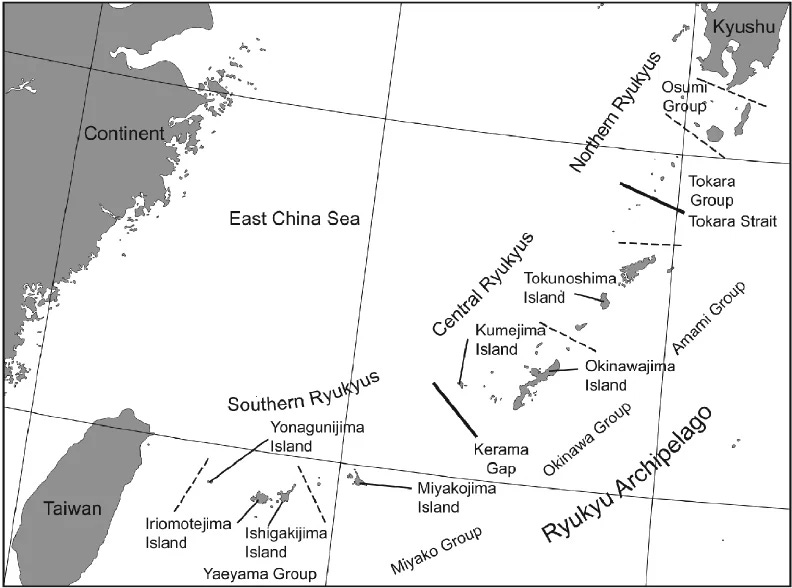
I have long been a proponent of increasing ferry links between Okinawa and Taiwan, in order to foster mutual understanding between the two peoples, given the immense sacrifice that will be imposed on Okinawa in the event of war.
Until today, it has not been publicly reported that among the ship’s crew are nationals of the People’s Republic of China. If China attacks or blockades Taiwan, Japan’s ability to evacuate civilians from the war zone may be dependent on ships crewed by Chinese nationals. Even more concerning, unvetted Chinese nationals have been given access to critical dual-use port infrastructure in Keelung port next to Taipei, home to one of Taiwan’s five naval logistic support commands as well as a Coast Guard base.
The security of Taiwan’s northern ports has come to the forefront in recent weeks after a fisherman found a Chinese rubber boat had illegally landed in New Taipei City. Two Chinese intruders were later detained by the Coast Guard following the civilian’s complaint, and it remains unclear whether the intruders were engaged in espionage, penetration testing, sabotage, smuggling, or any number of illegal activities threatening Taiwan’s sovereignty.
Yet Taiwanese and Japanese authorities seem unperturbed by the presence of unvetted Chinese seafarers in and around critical port infrastructure. Multinational crews are common on ocean liners and aircraft landing in Taiwan, but this is the first reported instance of Chinese crew in designated national security infrastructure. Taiwanese officials have refused to directly answer whether or not Chinese crew members are allowed to disembark in Keelung and how much access to the port they have.
Formosa Review submitted a detailed list of questions to a number of Taiwanese and Japanese government agencies about whether Chinese crew members of the Yaima Maru are vetted for ties to the Chinese military, intelligence services, United Front organizations, or whether they are allowed to disembark in Keelung, as well as the decision in the first place to employ Chinese crew members.
Authorities with the Port of Keelung reiterated Taiwanese regulations and laws governing access to ports and the issuance of temporary landing permits to Chinese seafarers. According to a manger of the port, who did not want to be publicly named in this report, responsibility for port security and screenings of Chinese crew members falls under the Maritime and Port Bureau of the Ministry of Transportation and Communications and the issuance of temporary landing permits the responsibility of the National Immigration Agency.
When reached for comment, Ms. Chiu from the Maritime and Port Bureau of the Ministry of Transportation and Communications stated that, as the Yaima Maru is a Panamanian-flagged vessel “neither the vessel nor its crew falls under our country’s jurisdiction.”
Ms. Chiu’s statement directly conflicted with a statement from a Keelung port official that “With respect to national security matters, [the National Immigration Agency] works with intelligence agencies and relevant authorities to conduct checks.”
Alice Hu of the National Immigration Agency, which falls under the Ministry of the Interior, issued a statement reiterating Taiwan’s existing regulations regarding the issuance of temporary entry permits to Chinese air or sea crew, which are issued for a maximum of three days. No answer was given as to whether any vetting is in place to ensure these crew members, even if they are not clearing immigration procedures and entering into Taiwan, do not have ties to Chinese military or intelligence services.
As the Yaima Maru is a Panamanian-flagged vessel “neither the vessel nor its crew falls under our country’s jurisdiction.”
-Taiwan’s Ministry of Transportation and Communications
When asked if any Chinese crew from the Yaima Maru had been issued entry permits to Taiwan, Ms. Hu declined to answer, citing privacy reasons. In prior cases, the agency has publicly confirmed it has issued entry permits to Chinese nationals, including a controversial case a few months ago when eight Chinese technicians were given entry permits to conduct sensitive work in Taiwan’s Taoyuan International Airport.
Nobody has come up with a credible explanation why the crew of the Yaima Maru, also made up of Taiwanese and Indonesians, includes so many Chinese nationals. Multiple inquiries to the ferry’s operator, Wagon Group, a Taiwanese shipping company with extensive business interests in China, went unanswered.
Written requests in Japanese to the Ishigaki city government, which is the main shareholder in the operation, as well as inquiries to multiple prefectural and national level agencies responsible for seafaring, disaster management, and defense coordination went unanswered. The sole response from any Japanese authority was an email from the Ships and Seafarers Division of the Transport Department of the Okinawa General Bureau, which confirmed the agency responsible for this issue would be the Crisis Management Division, Governor’s Office, Okinawa Prefectural Government. Written requests to this office have as of yet been unanswered.
Could the Yaima Maru be a “Trojan Seahorse?”
Over the past year, China has aggressively increased its attempts to assert sovereignty over waters east of Taiwan, including requesting foreign ships to identify themselves and their cargo and conducting provocative exercises with Indonesia’s navy. It also claims the Japanese-held Senkaku islands as its own, and has often lent its support to Okinawan independence movements, claiming that the status of the Ryukyus remains unresolved.
These are the very waters the Yaima Maru plies. Even short of a Taiwan contingency and even without the crew members entering Taiwan, the presence of unvetted Chinese crew members poses massive risks. Nobody knows who these young military-age Chinese citizens are: are they tried PLA Navy? They could be intelligence agents collecting human or signals intelligence along the critical Keelung-Yaeyama channel- a channel which is essential to Taiwan defeating an attempted Chinese blockade.
The current crew may simply be civilians, but surely future crew members could be substituted for trained agents or saboteurs. It would not take many individuals to hijack or disable the unguarded civilian ferry on the high seas.
One can easily imagine a scenario where Chinese agents among the crew, which have full access to passenger manifests, could discover “die-hard Taiwan separatists” such as Japanese-Taiwanese national Akio Yaita, who was recently assaulted by a Chinese agent in what Taiwan’s government has called an act of “transnational repression,” or DPP legislator and candidate for Taipei mayor Puma Shen, who is subject to a Chinese arrest warrant for his outspoken defense of Taiwan’s sovereignty.
It would be trivial for Chinese agents to disable the vessel and signal to Chinese Coast Guard ships waiting nearby to “provide aid,” during which a boarding party would arrest and detain the “die-hard separatists,” never to be seen again outside of a Chinese court room.
This is but one of dozens of scenarios Chinese agents aboard the ship could orchestrate. The range of possible incidents include disabling the ship to block channels into Keelung harbor, collecting intelligence on Taiwanese naval and coast guard facilities, smuggling illicit materials or individuals in or out of Taiwan, surveilling port facilities to help Chinese small boats enter undetected, and of course: impeding wartime evacuations.
It would be trivial for Chinese agents to disable the vessel and signal to Chinese Coast Guard ships waiting nearby to “provide aid,” during which a boarding party would arrest and detain the “die-hard separatists,” never to be seen again outside of a Chinese court room.
Somehow, on a Panamanian flagged ship owned by a Japanese city and operated by a Taiwanese private corporation with extensive financial ties to China, national security responsibilities seem to have fallen through the cracks.
When I asked one of the Taiwanese crew how it was working side-by-side with so many Chinese, he said relations were haihao (okay).
“You see,” he said, “on board, we are in Panama.”


