

Note: The following is an op-ed I wrote last year that was passed on by the Wall Street Journal amid initial discussions of a Saudi F-35 deal. Given recent news of US intelligence concerns that the deal may give China access to advanced US technologies, I have decided to publish it here. Written before the Iran War and prior to Trump’s de facto freeze on new arms sales to Taiwan, the core arguments still stand.
It would be a strategic and moral mistake for the United States to sell F-35 fighter jets to Saudi Arabia. The Crown Prince Mohammad bin Salman, the kingdom’s de facto ruler, is in Washington this week in an attempt to finally close the deal on a major acquisition of the world’s most advanced jet fighter, a feat of American innovation and engineering that contains our nation’s most closely guarded military secrets. Exporting the fighter to the Middle Eastern monarchy would reward the Saudi regime while risking exposing American military secrets to the Chinese.
Despite limited reforms under MBS, Saudi Arabia maintains one of the region’s worst human rights records, with rampant abuse of migrant workers, a backwards “guardianship” system that limits basic freedoms for women, and no tolerance for dissent. The brutal murder and dismemberment of Washington Post columnist Jamal Khashoggi in the Saudi consulate in Istanbul, purportedly directly on orders from MBS, remains an unblanched stain on the repressive Islamic autocracy. The F-35 would only enable the Saudi regime to further extend its repression beyond its borders. The Saudi Air Force has earned a reputation for particular cruelty in its bombing campaigns in Yemen, using American weapons against civilians in direct violation of US law.
If the Saudis’ own moral contraventions are not enough, their close military cooperation with China poses a direct threat to America’s national security interests. The F-35 contains closely guarded technological secrets that would be of great interest to China, which fields a similar but less-capable stealth fighter, the J-35. Saudi Arabia maintains extensive military ties with China, the United States’ foremost geopolitical adversary, hosting military advisors, embedding Chinese weapons systems into its military, and engaging in joint projects on missile development. Huawei, which has close ties to the PLA, is a major high technology and digital infrastructure player in Saudi Arabia, riddling the kingdom with spyware and digital backdoors for Chinese spies.
Saudi Arabia cannot be trusted to protect American technologies from Chinese spies, nor should the US place such sensitive military technology at risk. Should American secrets fall into Chinese hands in the desert, American pilots will die in the Pacific.
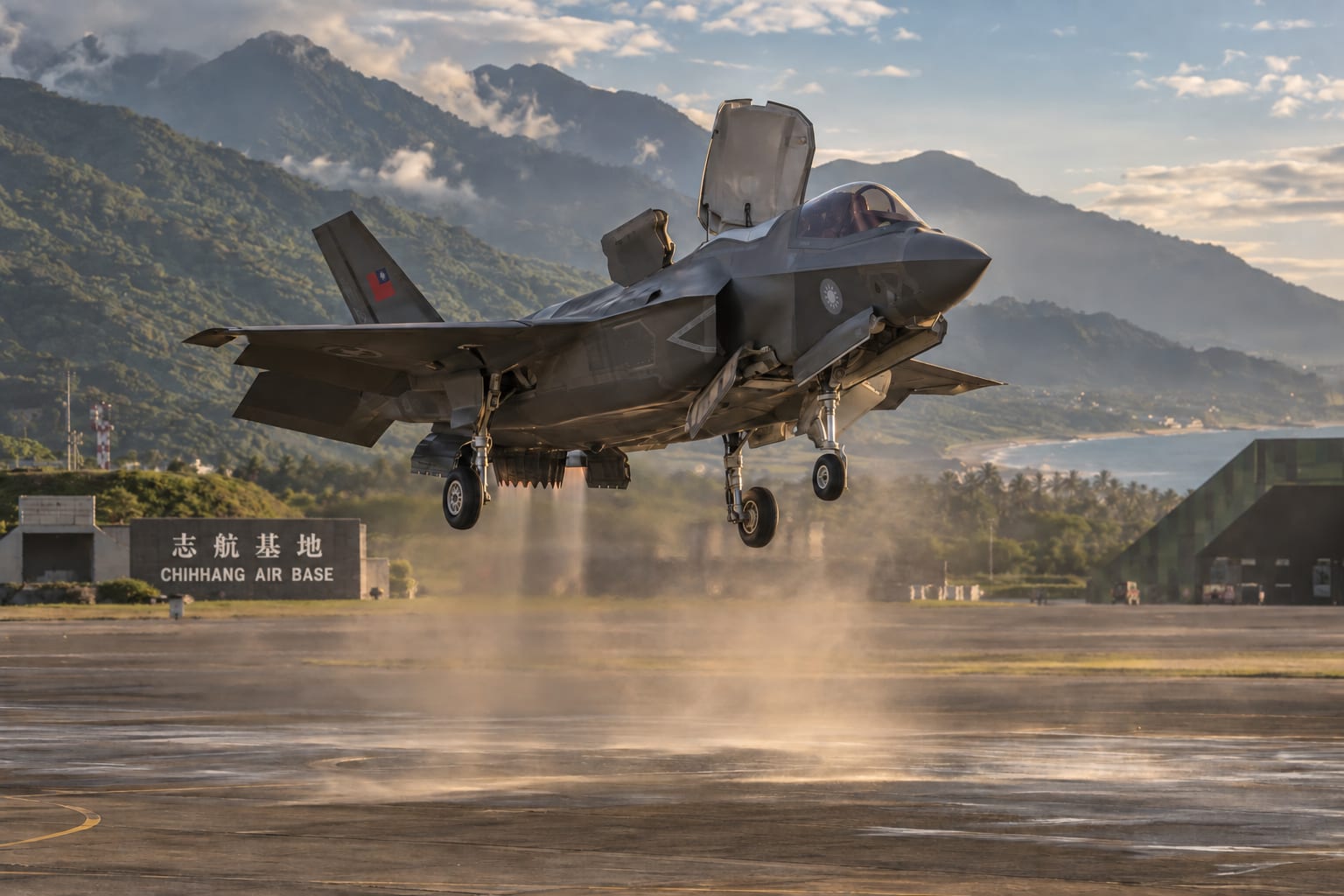
Trump should instead pursue a major sale of F-35s to Taiwan, which is seeking to upgrade its aging Air Force to deal directly with the Chinese threat. Although Taiwan has begun to upgrade to F-16V Vipers, it lacks fifth generation fighter jets and remains dependent on third-rate French and indigenously developed planes that would be next to useless against fifth generation Chinese fighter jets.
The F-35 B short and vertical takeoff variant would be a gamechanger for Taiwan’s Air Force. Taiwan is a small country, and its few runways remain incredibly vulnerable to a massive Chinese first strike. The F-35 B would fundamentally change Taiwan’s ability to survive a first strike, allowing it to disperse its air force more widely and get more planes in the air in a shorter amount of time.
A major arms sale of this magnitude would also solve a problem vexing both American and Taiwanese trade negotiators: how to reduce the enormous trade imbalance that exists between the two countries. Standing at nearly $74 billion and growing, the deficit is due to a structural imbalance in the two economies, where Taiwan exports high-demand semiconductors and other hardware consumed voraciously by US technology companies, yet price-conscious Taiwanese companies and consumers eschew expensive US exports.
Taiwan can finance this multibillion-dollar deal with its massive foreign currency reserves, having the added effect of forcing the New Taiwan Dollar to appreciate, which has been called “the world’s most undervalued currency.” Strengthening the NTD would also improve living standards for ordinary Taiwanese, lowering costs for essential imports of energy and food.
The problem with the proposed Saudi deal is that it is “Saudi First” not “America first.” It places Saudi interests ahead of core US national security interests, while achieving nothing of strategic value for the United States. Every day, Taiwanese pilots face down Chinese pilots in Taiwan’s Air Defense Identification Zone, intercepting Chinese fighters crossing the median line separating the two countries’ air spaces. It is in the United States strategic interest to ensure Taiwan’s air force is sufficiently armed against China’s formidable threat. The Saudis meanwhile face down Yemeni goatherders.
Unlike Saudi Arabia, Taiwan is a democracy that has always aligned itself closely with the United States, and holds the frontline against China in the First Island Chain. It makes strategic as well as moral sense for the United States to ensure its Pacific ally has the technology and firepower it needs not just to respond to a Chinese attack, but to deter it from ever happening in the first place. (November, 2025)
2026 Addendum
Nearly a year later and the United States, encouraged by Saudi Arabia, has entered into a losing war with Iran that has called into great question the entire basis of the US-Saudi alliance. The “Yemeni goatherders” I identified as Saudi Arabia’s primary adversary have now shot down a Saudi F-15 using asymmetric indigenous platforms. I have no doubt the appearance of a Saudi F-35 over Sanaa would surely give the Houthis their “Sorry, we didn’t know it was invisible” moment.

Donald Trump has continued his de facto arms freeze against Taiwan since his Beijing summit with Xi, and next week’s sequel in Washington will most likely result in Xi dangling another carrot to keep Trump kicking the arms sale decision down the road again and again. This has the additional affect of creating a crisis of confidence in US support within Taiwan, with the intention of inducing the Taiwanese to believe abandonment is inevitable and initiate surrender talks.
But this also gives Trump the opportunity to play the ultimate Trump card. At a time of rising skepticism of US commitments in the Indo-Pacific and falling munitions stockpiles, he has the opportunity to offer a deal with immense long-term deterrence dividends. The demonstration of US commitment to Taiwan would give Beijing considerable pause in the medium-term, and significantly boost advocates of stronger defense spending in Taipei, invigorating national confidence in deterring China.
I don’t expect any of this to happen- but there is no doubt that it would be a far, far more just outcome.