

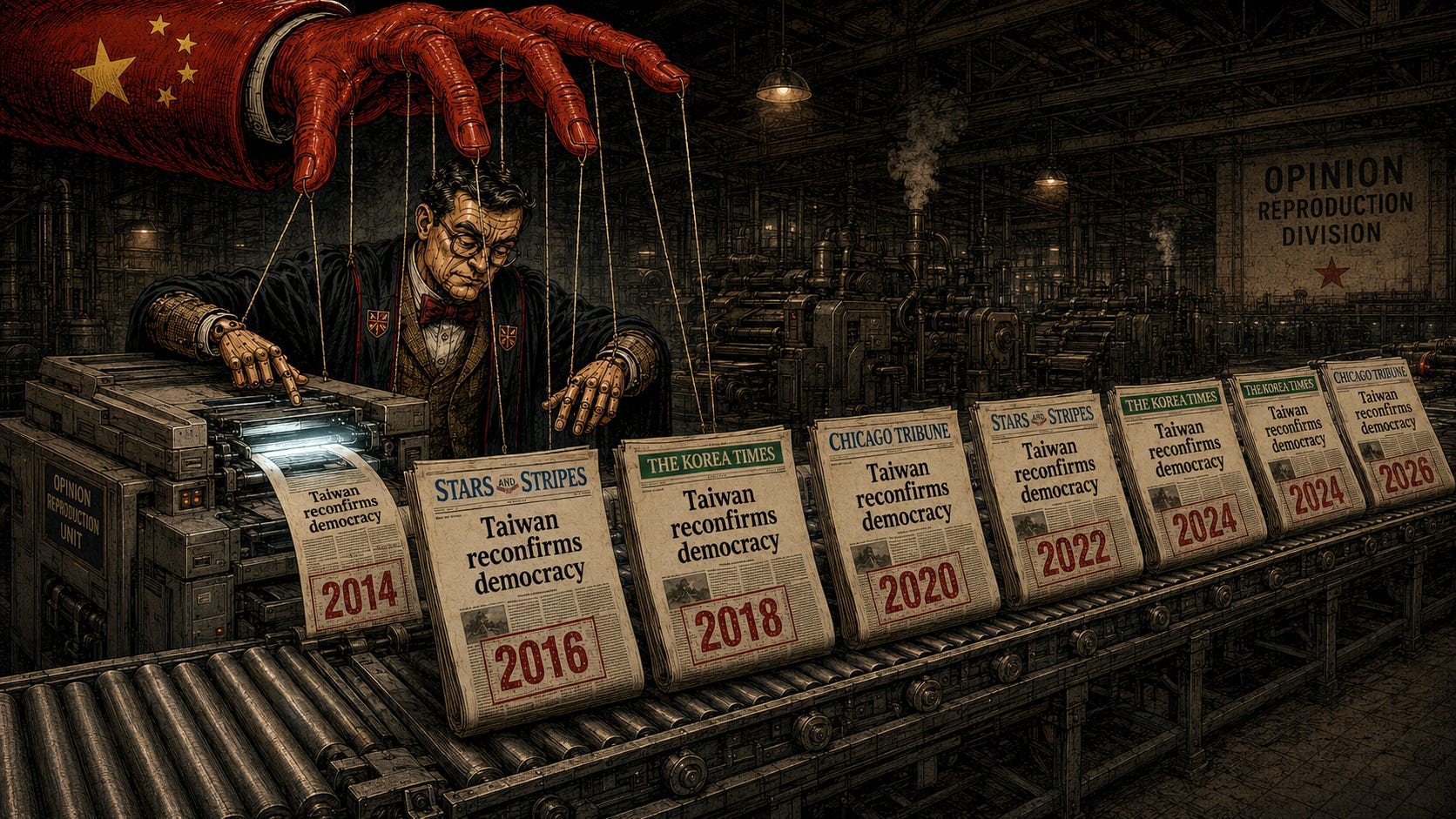
It’s been a tough week for opinions section editors, following embarrassing admissions from the Financial Times and Wall Street Journal that prominent contributors had written op-eds entirely with AI. That may just be the tip of the iceberg.
Analysis by Formosa Review indicates that a recent op-ed on Taiwan published in the Chicago Tribune was copy & pasted from a perpetually repackaged op-ed, likely updated with AI, possibly with Chinese models that hallucinated key elements of Taiwan’s history and politics with obvious factual errors. The author, Arthur I. Cyr, is a formerly tenured professor (now emeritus) of International Political Economy at Carthage College in Wisconsin.
The piece is in clear violation of at least one stated policy of the Chicago Tribune:
Op-eds must be wholly exclusive to the Tribune. We don’t want pieces that have been previously published — this includes on Substack and other newsletter sites — or pieces that have been superficially localized.
It is also quite likely in violation of a second Tribune policy:
We do not accept pieces that are generated or edited by AI to any degree.
The op-ed’s pro-China bent is one problem, serving to mislead the American public, but the basic factual errors throughout the piece make it clear that such a pro-China position can only be sustained through egregious misreadings of historical and present facts in Taiwan.
I will first highlight the explicit copy & paste nature of the op-ed, which has been repeatedly published in near identical form over the past 12 years, then address the egregious factual errors, before addressing the terminological and framing bent of the article and how it serves China’s propaganda needs both in the US and Taiwan.
Blatant Self-plagiarism
Nearly identical forms of the same op-ed have been published in 2014 in the Korea Times, in 2015 on Carthage College’s website, in 2016 in the Providence Journal, in 2024 in the Stars and Stripes, and on August 25, 2026 in the Chicago Tribune’s Lake County News-Sun.
Three paragraphs appear copied verbatim from the 2024 Stars and Stripes piece:
This continues significant political complications with mainland China. The Democratic Progressive Party (DPP) has won three presidential elections in a row. The party is formally committed to independence from China.
However, Mr. Lai’s vote margin was reduced, and the DPP also lost its legislative majority. The conservative Kuomintang (KMT) gained the most seats. Over time, this could prove a diplomatic plus given its more flexible relations with Beijing.
China is not happy about continued DPP control of the executive office, but greater KMT presence in the legislature provides opportunities for cultivation. China media have been relatively restrained about this election result compared to past extreme rhetoric.
Several paragraphs appear verbatim or with one or two word changes in all pieces from at least 2014-present:
The two sides share a bitter legacy of battle and blood. In 1949, Nationalist forces of General Chiang Kai-shek evacuated to Taiwan. Mao Zedong’s armies controlled the mainland of China. Except for the island territory, the communist revolution was complete.
The Korean War of 1950-1953 made the Cold War global, with China and the United States as direct combatants. U.S. commitment to Taiwan’s security became explicit.
The first DPP government, from 2000 to 2008, was able to finesse the political challenges with Beijing. Today, economic concerns remain more important than ideological purity for China’s challenged communist leadership.
Taiwan has become an essential investor for the enormous industrial revolution taking place on the mainland. Commercially successful, generally well-educated overseas Chinese in turn are a vital source of capital for the mainland. Expatriate Chinese also vote in Taiwan elections.
The foundation of cooperation has been built steadily, over time. Pragmatism characterizes Taiwan’s approach to mainland China. Following formal U.S. diplomatic recognition of Beijing in 1978, in consequence of President Richard Nixon’s 1972 visit, Taipei immediately launched a comprehensive essentially non-confrontational strategic response.
In 2010, the bilateral Economic Cooperation Framework Agreement (ECFA) was concluded. This was a major triumph for then-President Ma Ying-jeou. His election as chief executive in 2008 and 2012 greatly furthered rapprochement with Beijing, though negotiations on representative offices were unsuccessful.
Altogether, this copy & paste job accounts for more than 60% of the op-ed’s purported original writing, with most of the remainder made-up of mild tweaks of previously used language, such as:
The ECFA framework is now so strong that a return to earlier hostility across the Taiwan Strait is extremely unlikely. (2015, Carthage College)
The ECFA framework is now so strong that a return to earlier hostility across the Taiwan Strait is unlikely. (2024, Stars and Stripes)
The ECFA framework remains sufficient to prevent a return to unmitigated hostility. (2026, Chicago Tribune)
The Chicago Tribune declined to comment, citing that Mr. Cyr’s op-ed was published under the Lake County Sun subsidiary of the Chicago Tribune, claiming they have separate standards and editorial staff. The Lake County Sun is published on the Tribune website, its editors have Tribune emails, and it posts no separate editorial policy or indication that articles published under the Lake County Sun heading fall under a different set of policies than other articles similarly appearing on the Tribune website, under the Tribune’s masthead. The article has been further syndicated by the Tribune Media Company on various media including the official newspaper of the Department of Defense: Stars and Stripes.
Fact from Fiction
Compounding the professional ethical violations are the egregious factual errors that have now been repeated year after year as editor after editor has approved the same regurgitated slop for print. These errors at best misinform the public, and at worst advance China’s propaganda agenda pertaining Taiwan.
Mr. Cyr’s first factual error is a common one that in a different context might be viewed more charitably. He refers to the Kuomintang or Chinese Nationalist Party as the “conservative party,” when in reality it is a big tent nationalist party of Leninist origins and with left- and right-wing elements. Many of the KMT’s policies, particularly regarding state intervention in the market and expanding the welfare state, are decisively more left wing than the ruling Democratic Progressive Party, which is similarly a big tent nationalist party with left and right wings. The main difference between the two parties is one of nationalism: the KMT is a party of Chinese nationalism and the DPP is a party of Taiwanese nationalism, two strongly conflicting ideologies and the main ideological cleavage in Taiwanese politics.
Cyr claims that, following the January 2024 election of Lai Ching-te, “China [sic] media have been relatively restrained about this election result compared to past extreme rhetoric.”
He (or an AI agent) likely took the language of “relatively restrained” from a post-election Council on Foreign Relations report by David Sachs, which claimed China had a relatively restrained response in the days immediately following the election. In reality, China responded to the election by claiming that the election “cannot represent the mainstream public opinion on the island” and attacking foreign leaders for congratulating Lai and Taiwan on the successful election.
Just three days after Lai’s May 20, 2024 inauguration, China began massive aggressive war drills in the waters surrounding Taiwan, with Chinese officials stating that the drills should be interpreted as “strong punishment” to Mr. Lai. Cyr is far from the only commentator who echoed the “relatively restrained” interpretation following Lai’s election, but Cyr’s August 2026 article seems to be entirely unaware of any events after May 22, 2024. Most commentators, including on the pro-China end of the spectrum, have since revised their takes.
These errors at best misinform the public, and at worst advance China’s propaganda agenda pertaining Taiwan.
Cyr next writes bafflingly: “The first DPP government, from 2000 to 2008, was able to finesse the political challenges with Beijing. Today, economic interests remain more important than ideological purity for China.”
In reality, the first DPP government, under President Chen Shui-bian, faced unprecedented political pressure from China, including repeated threats to invade Taiwan, culminating in the 2005 passage of the Anti-Secession Law, a Chinese law that, while having no jurisdiction over Taiwan, asserts Beijing’s right to militarily invade Taiwan. The following sentence on economic interests overriding ideological purity makes no semantic sense, and syntactically reads as generative AI slop.
Cyr then positively presents the signing of controversial pacts opening up critical sectors of Taiwan’s market, including the media sector, to China, as successful triumphs for KMT President Ma Ying-jeou, whom he incorrectly refers to as Taiwan’s “Chief Executive,” a term not used in Taiwan, but used instead in Hong Kong. It’s possible the term was inserted by a Chinese AI model, as Chinese AI models are prohibited from referring to Taiwan’s elected leaders as “president,” however the first appearance of the error is in 2016, before the widespread advent of generative AI.
The hotly contested ECFA (Cross-Strait Economic Cooperation Framework Agreement) was not supported by a majority of the Taiwanese public, leading the Ma government to quash efforts to put the agreement to a referendum. When Ma attempted to force through a secretly negotiated addendum to the agreement in 2014, students organized the Sunflower Movement, occupying the legislature and stopping the government from passing the secret legislation through a backdoor “black box” method. The addendum has been shelved and remains deeply unpopular; since the Sunflower movement, no KMT candidate has won a presidential election in Taiwan.
Cyr then states one of the most egregious outright lies in the entire piece by stating that “Expatriate Chinese also vote in Taiwan elections.” This is simply false and has no basis in the truth. Only Taiwanese citizens have the right to vote in Taiwanese elections. Certainly, there are some naturalized citizens of Taiwan who are of ethnic Chinese background and may consider themselves “Expatriate Chinese,” but this is no category under Taiwanese law. Even expatriate Taiwanese are not eligible to vote in Taiwanese elections, with a prohibition on absentee voting and a requirement to maintain household registration in Taiwan to be eligible to vote.
Cyr closes the piece claiming ECFA has been a major success, and in fact to be a basis for expanded cooperation between Taiwan and China.
This is where Cyr’s self-plagiarism and dishonesty catches up with the facts. He first wrote some variation of the line “the ECFA framework remains sufficient to prevent a return to unmitigated hostility” in 2014, during the Ma Ying-jeou administration and the height of cross-strait cooperation, when indeed it could be feasible to claim that economic integration under ECFA would prevent a return to hostilities.
It seems Mr. Cyr has updated neither his prose nor his knowledge since 2014. Following the election of President Tsai Ing-wen, a major opponent of ECFA, in 2016, and the continued election of DPP presidents in 2020 and 2024, China has unilaterally cut off dialogue with Taiwan, escalated military exercises aimed at blockading or simulating an invasion of Taiwan, sent fighter jets nearly daily across the median line separating the two countries, in addition to extreme levels of grayzone aggression and transnational repression against Taiwan. It has issued arrest warrants for Taiwanese politicians, threatened invasion multiple times, fired missiles over Taiwan into Japan’s EEZ, and even illegally boarded Taiwanese civilian ferries.
By 2024, when Mr. Cyr was writing that ECFA was “now so strong that a return to earlier hostility across the Taiwan Strait is unlikely,” China had largely terminated much of the ECFA tariff reductions, with ECFA itself becoming a source of hostilities, rather than an impediment to them. Taiwan’s government has claimed that China has weaponized ECFA as a tool of economic coercion to attempt to influence Taiwanese politics and elections. ECFA has become wildly unpopular and Taiwan has reoriented its economy so it is no longer dependent on China, now counting the United States as its top trading partner.
Who gets to tell Taiwan’s story?
It is clear that Cyr has little understanding of Taiwan’s politics, history, or current affairs. Why then does he continuously churn out the same recycled take in every newspaper possible?
An overriding motif of his sole take on Taiwan is support for China’s view of history: he refers to China as “the mainland” and Taiwan as “the island,” and has effusive praise for President Ma Ying-jeou, who has largely faded from public view after public statements calling for “trusting Xi Jinping.” Ma left office with approval ratings of around 15%, and now struggles with what appears to be dementia.
Mr. Cyr does not speak with coherence on Taiwan. He praises DPP presidents, while calling for them to implement policies so extremely pro-China that even the KMT has backed away from them. His commentary evinces little understanding of Taiwan’s politics, national identity, or recent history. His lack of coherence perhaps indicates that he is not explicitly being directed by China, and he may not even be aware that he is furthering pro-China narratives, simply accepting willing direction from Chinese AI models.
But why have so many supposedly reputable US newspapers accepted and possibly paid for the same inaccurate, verbatim copy-pasted, trite essay for more than a decade? Does it say something about the laziness of these publications in covering one of the most important geopolitical hotspots in the world? Or something simpler about the lack of basic quality control, authentication, and fact-checking at second and third tier news outlets?
Perhaps it also says something about the reluctance of Taiwanese writers to put themselves and their voices forward to a broader variety of publications and media and tell Taiwan’s story well.
Publications in all languages need more and a wider variety of voices on Taiwan- especially from Taiwanese themselves. Taiwanese, often humble and deferential (in contrast to many Americans), tend to be reluctant to write in foreign media, sometimes due to concerns about their own English writing capabilities or stature.
Yet the Cyr example demonstrates that literally anyone with low expertise and low quality of analysis can be widely syndicated. Taiwanese should take note. Non-native English speakers can responsibly use AI for grammar assistance, when appropriately disclosed, or co-write with foreign native-speaking authors if needed.
One of the most important and underappreciated recent developments in the pro-Taiwan media space has been the emergence of the Taiwan Advocacy Project, a great initiative offering rewards of up to 100,000 NTD (~3000 USD) for Taiwanese authors published in a wide range of foreign media. I hope that as many English-speaking Taiwanese as possible take up the challenge and tell the world the truth about Taiwan- the demand for information about Taiwan continues to outpace the production of accurate information about the country.
Professor Cyr did not respond to a request for comment.