

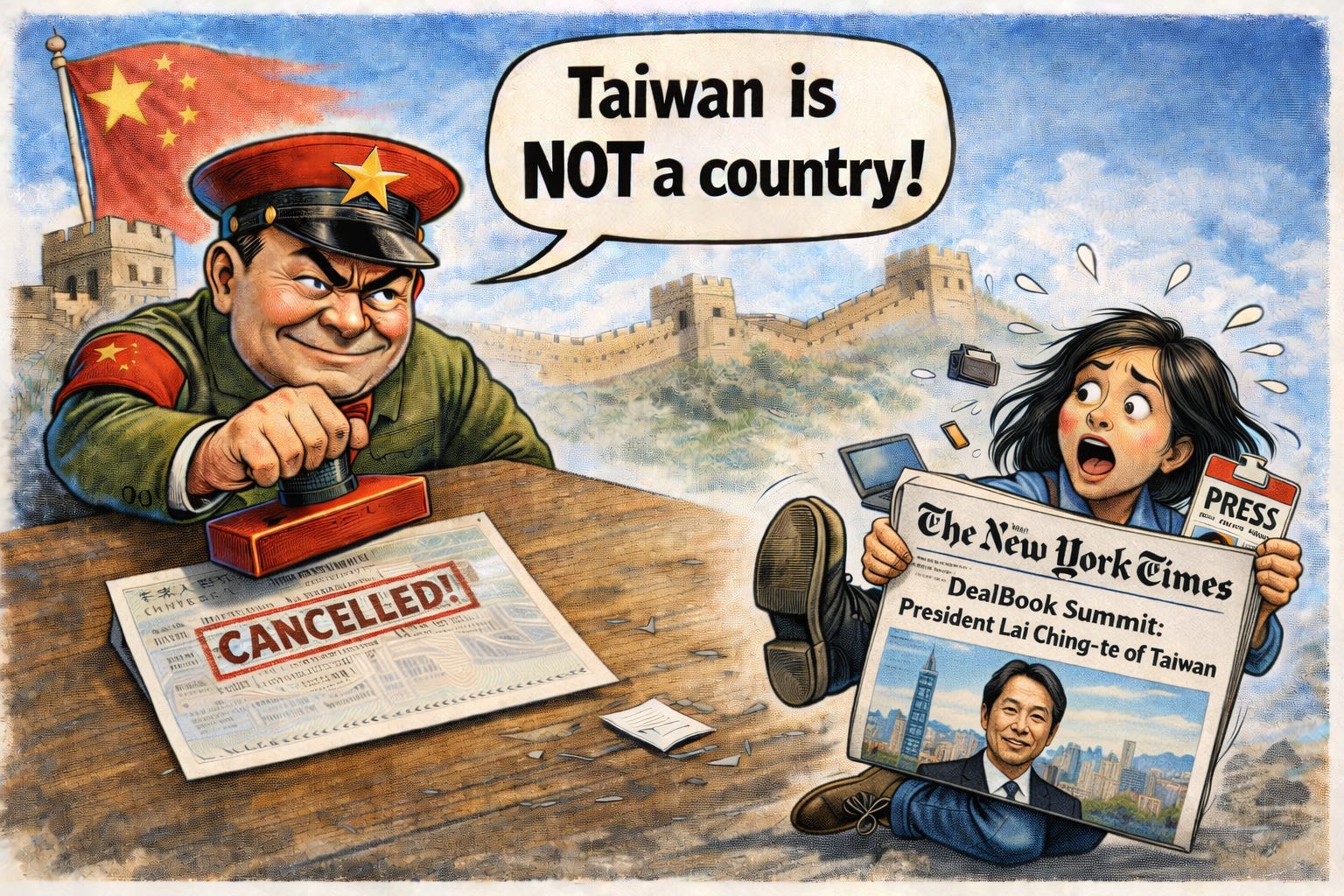
Formosa Review can exclusively confirm that earlier this month Beijing refused to renew the visa of the New York Times’ longtime China correspondent Vivian Wang, effectively expelling her from the country after six years on the ground. The visa denial, which came as she was outside the country reporting from Seoul, was ostensibly in response to the virtual appearance of Taiwanese president Lai Ching-te this past December at the Times’ DealBook Summit, where host Andrew Ross Sorkin referred to Taiwan as a “country,” breaking with the Times’ longstanding practice of denying Taiwan’s existence as a sovereign and independent country.
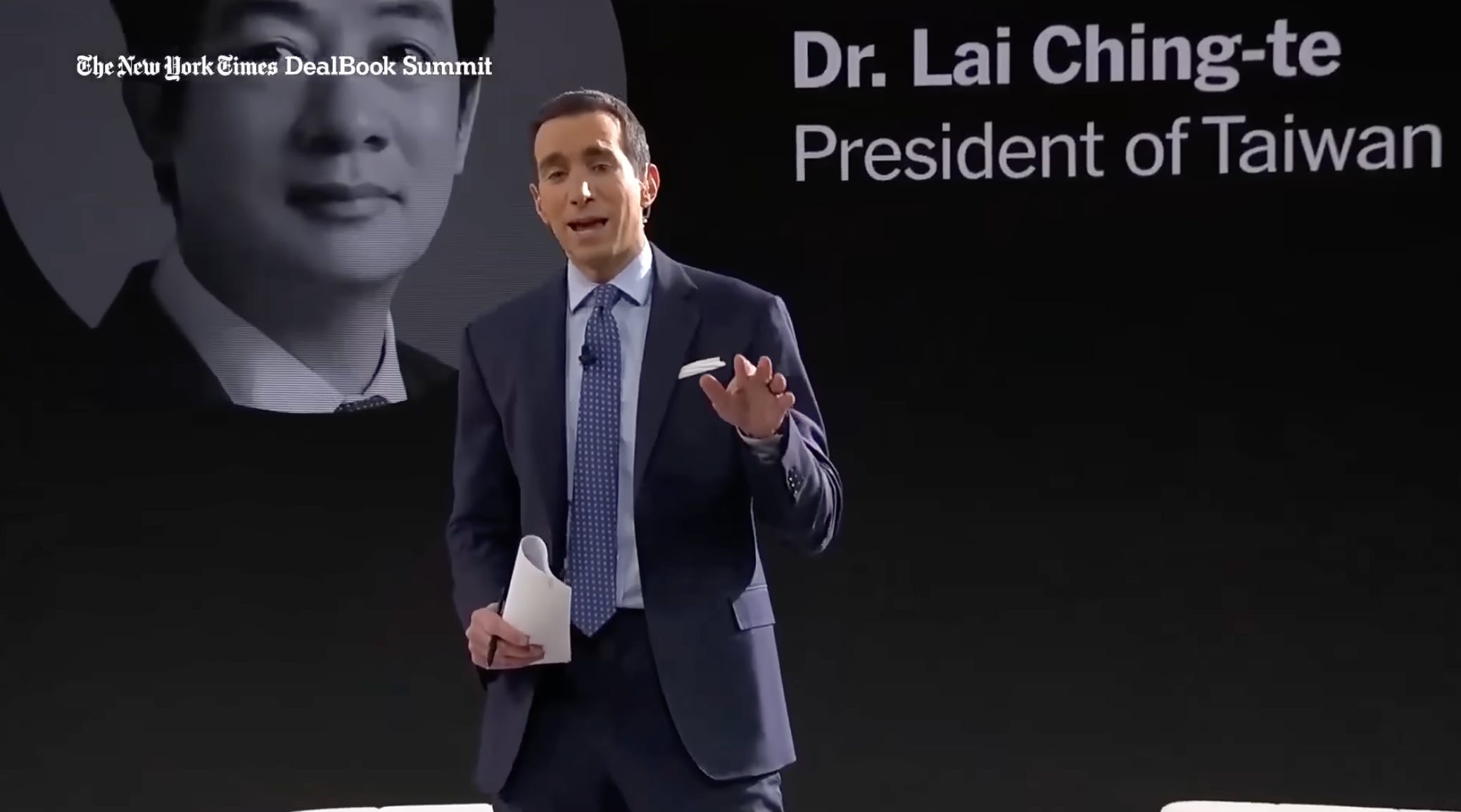
“We’re going to show you a rare and exclusive interview with Taiwan’s president… his country is not merely a neighbor to China, it is a democratic self-governed island.”
Andrew Ross Sorkin introduces Taiwanese president William Lai Ching-te at the DealBook Summit
Beijing has long wielded access to the country in an attempt to shape coverage, or punish coverage it disapproves of, through strict visa restrictions and expulsions. Foreigners are expressly prohibited from conducting journalism in the country unless entering under a journalism visa, known as a J-visa, for both long and short-term reporting. Foreign correspondents stationed in China must renew their J1 visas annually, a process which is often used to pressure foreign media over coverage displeasing to Beijing.
Press freedom watchdog RSF has called this “visa blackmail,” and the Foreign Correspondents’ Club of China has extensively documented how visa restrictions, or threats thereof, have been directed at reporters from countries with tensions with China or as a response to reporting on sensitive issues such as human rights or corruption.
Despite having consistently correctly referred to Taiwan as a “country” in past coverage, the Times has bent over backwards over the past three decades to hew to Beijing’s propaganda by not only refusing to call Taiwan a country, but inventing nonsensical monikers for the East Asian archipelagic nation, such as “democratically governed island” or “not-quite nation.”
Taiwan is, of course, not a single island but an archipelago, as the Times and other international media frequently remind us through their strange obsession with Kinmen, a cluster of islets under Taiwanese control, yet of little importance or meaning to Taiwan.
And while Taiwanese nationalism has evolved over the decades, it long predates Taiwan’s independence, and certainly exists today. For some reason, the Times has unilaterally decided that there is no Taiwanese nation, while also determining it acceptable to refer to Scotland as a “country,” despite the fact that the semi-autonomous British region has no passport, no currency, no constitution, no military, nor customs or immigration controls of its own.
Instead of punishing the New York Times, the authorities in Beijing should be thanking them for the decades of work they have put in to mislead readers about Taiwan’s status.